


Elite Travel
  • Vacation Types
    • Luxurious Vacations
    • Travel Insurance
    • Group Travel
    • Destination Weddings
      • Caribbean and Mexico Destination Weddings
      • Destination Weddings in Europe
      • Micro Destination Weddings
    • Honeymoon
    • All-Inclusive
    • Incentive Travel
      • Group Incentive Travel
      • Individual Incentive Travel
      • Corporate Incentive Travel
      • Company Incentive Program
    • Luxury Cruises
    • Adventure Travel
    • Solo Travel
    • Wellness Travel
    • Short Getaways and More
    • Elite Vip Groups
      • Blue Zone Experiences
    • Luxury Charity Vacation Packages
  • Destinations
    • Europe
      • Greece
        • Athens
        • Corfu
        • Crete
        • Delphi
        • Ikaria
        • Meteora
        • Mykonos
        • Naxos
        • Paros
        • Patmos
        • Rhodes
        • Santorini
        • Zakynthos
      • Italy
        • Alberobello
        • Amalfi
        • Apulia
        • Bari
        • Dolomites
        • Florence
        • Lake Como
        • Lecce
        • Matera
        • Milan
        • Naples
        • Positano
        • Rome
        • Sardinia
          • Alghero
          • Cagliari
          • Olbia
          • Su Gologone
        • Sicily
        • Sorrento
        • Venice
        • Verona
      • Spain
        • Barcelona
        • Granada
        • Madrid
        • Ibiza
        • Seville
        • Valencia
      • Portugal
        • Porto
        • Faro
        • Lisbon
        • Douro Valley
      • France
        • French Alps
        • Paris
        • Nice
      • Ireland
        • Aran Islands
        • Dingle Peninsula
        • Dublin
        • Galway
        • Killarney
      • Iceland
      • Scotland
      • England
        • London
      • Croatia
      • Austria
      • Norway
      • Netherlands
      • Cyprus
      • Germany
      • Hungary
      • Sweden
      • Switzerland
      • Turkey
    • Caribbean
      • Aruba
      • Bahamas
      • Barbados
      • Bermuda
      • Cayman Islands
      • Dominican Republic
        • Cap Cana
        • La Romana
        • Punta Cana
      • Jamaica
      • Puerto Rico
      • St. Barts
      • St. John
      • St. Kitts and Nevis
      • St. Lucia
      • St. Martin
      • St. Thomas
      • Turks and Caicos
    • Mexico
      • Cancun
      • Los Cabos
      • Riviera Maya
      • Puerto Vallarta
    • Central America
      • Belize
      • Costa Rica
      • Panama and Nicaragua
    • South America
      • Argentina
      • Brazil
      • Colombia
      • Ecuador
        • Quito
      • Peru
      • Venezuela
    • North America
      • Canada
      • United States
        • Alaska
        • Colorado
        • Florida
        • Hawaii
          • Big Island
          • Kauai
          • Maui
    • Oceania
      • Australia
        • Adelaide
        • Brisbane
        • Cairns
        • Kangaroo Island
        • Melbourne
        • Sydney
      • Fiji
      • French Polynesia
      • New Zealand
      • Tasmania
    • Asia
      • Thailand
        • Bangkok
        • Chiang Mai
        • Phuket
        • Phi Phi Islands
      • Japan
      • Bali
      • Vietnam and Cambodia
      • Philippines
      • India
    • Middle East
      • Abu Dhabi
      • Dubai
      • Israel
      • Jordan
    • Africa
      • Egypt
      • Ghana
      • Kenya
      • South Africa, Cape Town, and Botswana
      • Morocco
    • Antarctica
  • Testimonialswhat others are saying
  • About
    • Meet Our CEO
    • It’s My Bag
    • Press
    • ABC TV Show
    • Just Go Trav
    • Trip Giveaway
  • Contact
    • Newsletter
  • (727) 726-9090
info@elitetravelgroup.net
Elite Travel
  • Vacation Types
    • Luxurious Vacations
    • Travel Insurance
    • Group Travel
    • Destination Weddings
      • Caribbean and Mexico Destination Weddings
      • Destination Weddings in Europe
      • Micro Destination Weddings
    • Honeymoon
    • All-Inclusive
    • Incentive Travel
      • Group Incentive Travel
      • Individual Incentive Travel
      • Corporate Incentive Travel
      • Company Incentive Program
    • Luxury Cruises
    • Adventure Travel
    • Solo Travel
    • Wellness Travel
    • Short Getaways and More
    • Elite Vip Groups
      • Blue Zone Experiences
    • Luxury Charity Vacation Packages
  • Destinations
    • Europe
      • Greece
        • Athens
        • Corfu
        • Crete
        • Delphi
        • Ikaria
        • Meteora
        • Mykonos
        • Naxos
        • Paros
        • Patmos
        • Rhodes
        • Santorini
        • Zakynthos
      • Italy
        • Alberobello
        • Amalfi
        • Apulia
        • Bari
        • Dolomites
        • Florence
        • Lake Como
        • Lecce
        • Matera
        • Milan
        • Naples
        • Positano
        • Rome
        • Sardinia
          • Alghero
          • Cagliari
          • Olbia
          • Su Gologone
        • Sicily
        • Sorrento
        • Venice
        • Verona
      • Spain
        • Barcelona
        • Granada
        • Madrid
        • Ibiza
        • Seville
        • Valencia
      • Portugal
        • Porto
        • Faro
        • Lisbon
        • Douro Valley
      • France
        • French Alps
        • Paris
        • Nice
      • Ireland
        • Aran Islands
        • Dingle Peninsula
        • Dublin
        • Galway
        • Killarney
      • Iceland
      • Scotland
      • England
        • London
      • Croatia
      • Austria
      • Norway
      • Netherlands
      • Cyprus
      • Germany
      • Hungary
      • Sweden
      • Switzerland
      • Turkey
    • Caribbean
      • Aruba
      • Bahamas
      • Barbados
      • Bermuda
      • Cayman Islands
      • Dominican Republic
        • Cap Cana
        • La Romana
        • Punta Cana
      • Jamaica
      • Puerto Rico
      • St. Barts
      • St. John
      • St. Kitts and Nevis
      • St. Lucia
      • St. Martin
      • St. Thomas
      • Turks and Caicos
    • Mexico
      • Cancun
      • Los Cabos
      • Riviera Maya
      • Puerto Vallarta
    • Central America
      • Belize
      • Costa Rica
      • Panama and Nicaragua
    • South America
      • Argentina
      • Brazil
      • Colombia
      • Ecuador
        • Quito
      • Peru
      • Venezuela
    • North America
      • Canada
      • United States
        • Alaska
        • Colorado
        • Florida
        • Hawaii
          • Big Island
          • Kauai
          • Maui
    • Oceania
      • Australia
        • Adelaide
        • Brisbane
        • Cairns
        • Kangaroo Island
        • Melbourne
        • Sydney
      • Fiji
      • French Polynesia
      • New Zealand
      • Tasmania
    • Asia
      • Thailand
        • Bangkok
        • Chiang Mai
        • Phuket
        • Phi Phi Islands
      • Japan
      • Bali
      • Vietnam and Cambodia
      • Philippines
      • India
    • Middle East
      • Abu Dhabi
      • Dubai
      • Israel
      • Jordan
    • Africa
      • Egypt
      • Ghana
      • Kenya
      • South Africa, Cape Town, and Botswana
      • Morocco
    • Antarctica
  • Testimonialswhat others are saying
  • About
    • Meet Our CEO
    • It’s My Bag
    • Press
    • ABC TV Show
    • Just Go Trav
    • Trip Giveaway
  • Contact
    • Newsletter
  • (727) 726-9090
  • Vacation Types
    • Luxurious Vacations
    • Travel Insurance
    • Group Travel
    • Destination Weddings
      • Caribbean and Mexico Destination Weddings
      • Destination Weddings in Europe
      • Micro Destination Weddings
    • Honeymoon
    • All-Inclusive
    • Incentive Travel
      • Group Incentive Travel
      • Individual Incentive Travel
      • Corporate Incentive Travel
      • Company Incentive Program
    • Luxury Cruises
    • Adventure Travel
    • Solo Travel
    • Wellness Travel
    • Short Getaways and More
    • Elite Vip Groups
      • Blue Zone Experiences
    • Luxury Charity Vacation Packages
  • Destinations
    • Europe
      • Greece
        • Athens
        • Corfu
        • Crete
        • Delphi
        • Ikaria
        • Meteora
        • Mykonos
        • Naxos
        • Paros
        • Patmos
        • Rhodes
        • Santorini
        • Zakynthos
      • Italy
        • Alberobello
        • Amalfi
        • Apulia
        • Bari
        • Dolomites
        • Florence
        • Lake Como
        • Lecce
        • Matera
        • Milan
        • Naples
        • Positano
        • Rome
        • Sardinia
          • Alghero
          • Cagliari
          • Olbia
          • Su Gologone
        • Sicily
        • Sorrento
        • Venice
        • Verona
      • Spain
        • Barcelona
        • Granada
        • Madrid
        • Ibiza
        • Seville
        • Valencia
      • Portugal
        • Porto
        • Faro
        • Lisbon
        • Douro Valley
      • France
        • French Alps
        • Paris
        • Nice
      • Ireland
        • Aran Islands
        • Dingle Peninsula
        • Dublin
        • Galway
        • Killarney
      • Iceland
      • Scotland
      • England
        • London
      • Croatia
      • Austria
      • Norway
      • Netherlands
      • Cyprus
      • Germany
      • Hungary
      • Sweden
      • Switzerland
      • Turkey
    • Caribbean
      • Aruba
      • Bahamas
      • Barbados
      • Bermuda
      • Cayman Islands
      • Dominican Republic
        • Cap Cana
        • La Romana
        • Punta Cana
      • Jamaica
      • Puerto Rico
      • St. Barts
      • St. John
      • St. Kitts and Nevis
      • St. Lucia
      • St. Martin
      • St. Thomas
      • Turks and Caicos
    • Mexico
      • Cancun
      • Los Cabos
      • Riviera Maya
      • Puerto Vallarta
    • Central America
      • Belize
      • Costa Rica
      • Panama and Nicaragua
    • South America
      • Argentina
      • Brazil
      • Colombia
      • Ecuador
        • Quito
      • Peru
      • Venezuela
    • North America
      • Canada
      • United States
        • Alaska
        • Colorado
        • Florida
        • Hawaii
          • Big Island
          • Kauai
          • Maui
    • Oceania
      • Australia
        • Adelaide
        • Brisbane
        • Cairns
        • Kangaroo Island
        • Melbourne
        • Sydney
      • Fiji
      • French Polynesia
      • New Zealand
      • Tasmania
    • Asia
      • Thailand
        • Bangkok
        • Chiang Mai
        • Phuket
        • Phi Phi Islands
      • Japan
      • Bali
      • Vietnam and Cambodia
      • Philippines
      • India
    • Middle East
      • Abu Dhabi
      • Dubai
      • Israel
      • Jordan
    • Africa
      • Egypt
      • Ghana
      • Kenya
      • South Africa, Cape Town, and Botswana
      • Morocco
    • Antarctica
  • Testimonialswhat others are saying
  • About
    • Meet Our CEO
    • It’s My Bag
    • Press
    • ABC TV Show
    • Just Go Trav
    • Trip Giveaway
  • Contact
    • Newsletter
  • (727) 726-9090
Elite Travel
  • Vacation Types
    • Destinations
      • Luxury Granada Vacation Packages
      • Luxury Seville Vacation Packages
      • Luxury Madrid Vacation Packages
    • Elite Vip Groups
      • Luxury Valencia Vacation Packages
      • Luxury Ibiza Vacation Packages
    • Testimonials
      • Luxury Big Island Vacation Packages
  • About Us
  • Contact Us
  • Lets start planning
Home » Travel » Page 6
Category:

Travel

Couple packing luxury luggage for honeymoon
Travel

Your Step-by-Step Honeymoon Itinerary for Newlyweds

by Tammy Levent August 8, 2026
written by Tammy Levent

The most effective honeymoon itinerary follows a simple rhythm: one big experience per day, intentional buffer days built in, and every booking locked in the right order. Whether you have three days or ten, the structure below gives you a ready-to-use plan you can copy right now, plus a five-minute starter checklist to get moving before you close this tab.

Your five-minute starter checklist:

  • Decide your travel window (how many days you realistically have after the wedding)
  • Choose your honeymoon style: minimoon, one-base, or split-stay
  • Identify your single must-have experience or destination anchor
  • Open a dedicated savings account or honeymoon registry fund
  • Write one sentence describing your ideal trip (you’ll use it to guide every booking)

Three ready-to-use templates are covered below: a 3-day minimoon, a 7-day one-base, and a 10-day split-stay. Jump to the sample itineraries section if you want the day-by-day layouts now, or read through the full planning guide to build your own from scratch.


Key Takeaways

A well-structured honeymoon itinerary limits big activities to one per day, builds in buffer days, and locks premium inventory 6–12 months before departure.

PointDetails
Book premium inventory firstOverwater villas and safari camps often sell out many months in advance; book these early.
Add about one-sixth contingencyBudget about one-sixth buffer above your planned total to cover upgrades, surprises, and unexpected costs.
One big activity per dayCap each day at one major experience to avoid fatigue and keep the trip feeling romantic rather than rushed.
Use the three-act arcStructure your trip to decompress initially, enjoy key anchor moments mid-trip, and wind down toward the end.
Elitetravelgroup for complex tripsFor multi-stop or ultra-luxury honeymoons, engage Elitetravelgroup well before departure to access premium inventory and bespoke itinerary design.

Table of Contents

  • How do you create a step-by-step honeymoon itinerary?
  • How should you set a honeymoon budget?
  • How do you choose the right destination and travel dates?
  • What is the right booking timeline for a honeymoon?
  • How do you pace a honeymoon itinerary day by day?
  • Three copyable day-by-day honeymoon templates
  • What travel documents and health prep do you need?
  • What should you pack and do the week before you leave?
  • When does hiring a honeymoon planner actually make sense?
  • A planner’s honest take on what most couples get wrong
  • Elitetravelgroup’s bespoke honeymoon planning: how to get started
  • Sources

How do you create a step-by-step honeymoon itinerary?

Start with your vision, not your destination. Most couples make the mistake of picking a place first and then trying to fit their preferences around it. Flip that order. Answer four questions together before you open a single booking site:

  • How much time do you have? Be honest. If you’re exhausted from wedding planning, five days of beach is better than ten days of island-hopping.
  • What’s your energy level? Adventure-first or rest-first? One of you may want to hike at sunrise; the other may want coffee on a terrace until noon.
  • How far are you willing to fly? A 14-hour flight eats two days of a seven-day trip.
  • What’s the one thing you’d regret missing? That answer becomes your anchor experience.

Honeymoon types and which one fits you

Zola’s honeymoon planning guide recommends deciding your honeymoon type early because every other decision, budget, timing, and destination, follows from it.

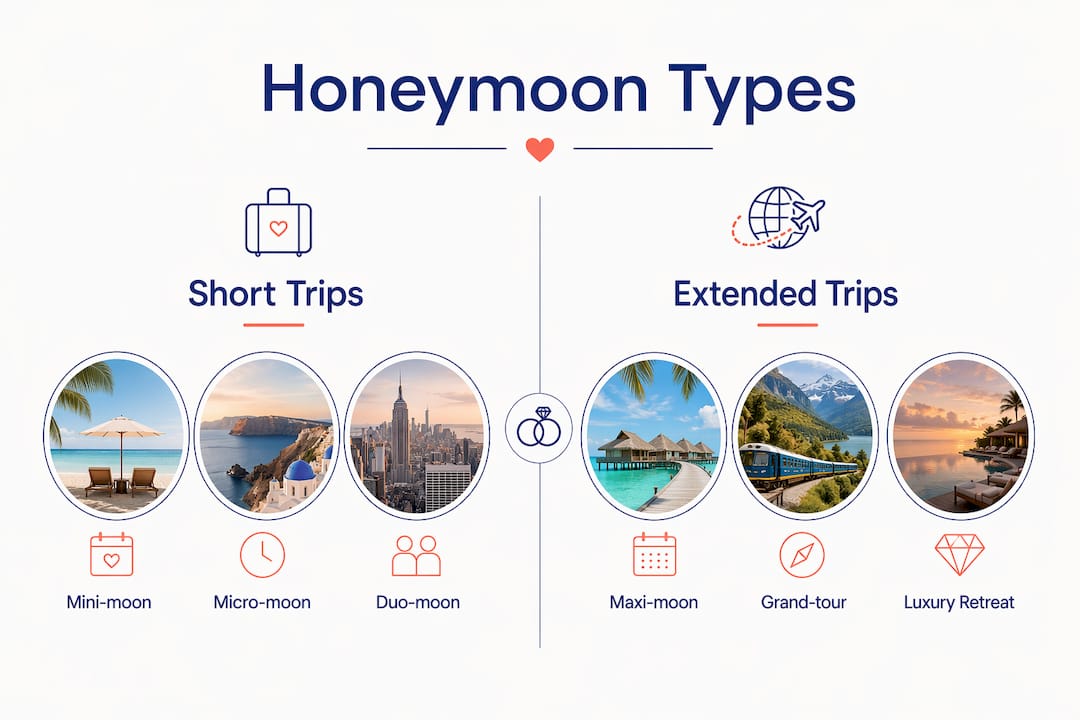
  • Minimoon (2–4 nights): A short, nearby trip taken right after the wedding, often followed by a longer trip later. Perfect for couples who are tired, budget-conscious, or planning a bigger trip for an anniversary.
  • Maximoon (10–14+ nights): The full, once-in-a-lifetime trip. Requires more planning lead time and a larger budget, but delivers the depth most couples dream about.
  • One-base: You stay in one place the entire trip. Lower logistics stress, more time to actually relax, and easier to go deep on a single destination.
  • Split-stay: Two locations, sometimes two countries. Adds variety but also adds transit days. Best for trips of nine nights or more.
  • Voluntourism: Combines travel with a meaningful project. Niche but growing, and works well for couples who find purpose-driven travel more fulfilling than pure leisure.

Once you’ve chosen your type, write a single sentence: “We want a [type] honeymoon in [region], focused on [anchor experience], for [number] nights.” That sentence will guide every booking decision you make.

Pro Tip: Bespoke honeymoon advisors often ask “what does a perfect morning look like for each of you?” before they suggest a single destination. Try answering that question together — the gap between your two answers tells you exactly how much structure your itinerary needs.


How should you set a honeymoon budget?

Budget before you book. Couples who skip this step consistently overspend on flights and accommodation, then run short on the experiences that actually make the trip memorable.

A practical allocation framework for a two-person honeymoon:

That buffer covers flight upgrades, a spontaneous dinner reservation, or a last-minute activity you didn’t anticipate, and it’s a standard recommendation from honeymoon planning resources for exactly this reason.

Funding options worth knowing

  • Dedicated savings account: Open one the moment you get engaged. Automate a monthly transfer so the fund grows without effort.
  • Honeymoon registry or cash fund: Platforms like Zola and The Knot let guests contribute directly to specific experiences (a sunset cruise, a spa day, a private dinner) rather than giving physical gifts. Itemized asks tend to get more participation than a generic cash pool.
  • Credit card points: If you’re not already using a travel rewards card, start now. Points accumulated during wedding vendor payments can cover flights or hotel nights. Transfer partners vary by card issuer, so check which airline and hotel programs your card connects to.

Pro Tip: When building your registry, list specific experiences with photos and descriptions, not just dollar amounts. “Sunset catamaran sail for two” gets funded faster than “Honeymoon fund contribution.”


How do you choose the right destination and travel dates?

Seasonality is the most underestimated variable in honeymoon planning. A destination that looks perfect in photos can be underwater, overpriced, or overrun with crowds depending on when you go.

Key rules for matching your wedding date to a destination:

  • Hurricane season (June–November): The Caribbean and parts of Mexico carry real storm risk during this window. Rates drop significantly, but travel insurance becomes non-negotiable.
  • Monsoon season: Southeast Asia (Thailand, Bali, Vietnam) sees heavy rain from roughly May through October depending on the region. The shoulder months on either side often offer the best value with manageable weather.
  • European high season (June–August): Popular destinations like the Amalfi Coast, Santorini, and Paris see peak crowds and peak prices. April–May and September–October offer better availability and cooler temperatures.
  • Southern Hemisphere timing: If you’re marrying in December or January and want summer weather, consider New Zealand, South Africa, or Australia, where it’s midsummer.

Check current honeymoon travel trends for destination-specific timing advice before you commit.

Flight time and the one-base vs. split-stay decision

Flight time directly eats into your trip. A 14-hour flight to the Maldives on a seven-day honeymoon leaves you five days on the ground after accounting for jet lag and travel days. For trips under seven nights, keep your destination within a six-to-eight hour flight from home.

Tropical beach at sunset with calm water

For multi-destination trips, planning guidance recommends limiting to two locations for trips of 7–12 nights. More than two locations increases transit time and erodes the relaxation you’re paying for.

Passport and visa quick check: Most countries require your passport to be valid for at least six months beyond your travel dates. If you’re changing your name after the wedding, book flights under your current legal name and update documents before your next trip. Visa processing times vary widely; check the U.S. Department of State’s travel site for your specific destination well in advance.

For a shorter domestic option, the Destin, Florida area is a strong minimoon candidate for couples in the Southeast, with white-sand beaches, calm Gulf waters, and no passport required.


What is the right booking timeline for a honeymoon?

The Knot’s honeymoon planning timeline and My Honeymoon Hotel’s complete guide both recommend starting 9–12 months out for popular destinations and premium inventory. Here’s the month-by-month breakdown:

12–9 months before departure

  1. Decide your honeymoon type and write your vision sentence.
  2. Set your total budget and open a dedicated savings or registry fund.
  3. Research destination seasonality and narrow to two or three options.
  4. Check passport validity and start any name-change process if needed.
  5. Book flights. The sweet spot for international airfare is typically 60–110 days before departure, but for peak-season travel, locking in earlier protects availability.
  6. Book your primary accommodation. Overwater villas, safari camps, and boutique hotels with limited rooms sell out 6–12 months in advance.

6 months before departure

  • Confirm visa requirements and apply if needed.
  • Book any must-do experiences with limited capacity: private tours, cooking classes, hot-air balloon rides, or exclusive restaurant reservations.
  • Purchase travel insurance. Do this as soon as you book your first non-refundable item so pre-existing condition waivers apply.
  • Start your honeymoon planning guide research for day-by-day activity ideas.

3 months before departure

  • Book remaining activities and restaurant reservations (30–90 days is the standard window for most dining and excursion bookings).
  • Arrange airport transfers and any inter-island or inter-city transport.
  • Schedule a travel clinic appointment if vaccines are required (some require a series over several weeks).
  • Finalize your packing list and identify any gear you need to buy.

1 month before departure

  • Reconfirm all reservations: flights, hotels, transfers, and activities.
  • Notify your bank and credit card companies of your travel dates and destinations.
  • Order any foreign currency you’ll need for cash-only markets or tipping.
  • Set up an international phone plan or purchase an eSIM for your destination.

1–2 weeks before departure

  • Send pre-arrival emails to your hotel noting any special occasions (honeymoon, dietary needs, room preferences).
  • Print or screenshot all confirmations and save them offline.
  • Arrange pet care, house-sitting, or mail hold.
  • Pack and weigh luggage to avoid airline fees.

Day before departure

  • Charge all devices and pack adapters for your destination’s outlet type.
  • Confirm your airport transfer pickup time.
  • Pack a carry-on with all travel documents, medications, a change of clothes, and valuables.
  • Hand off any wedding-related responsibilities (gifts, keys, vendor follow-ups) to a trusted person.

Booking priority callout: Overwater villas in the Maldives and French Polynesia, private safari camps in Kenya and Tanzania, and small-ship cruise cabins tend to be the earliest to sell out. If any of these are on your list, treat them as your first booking, not your last.


How do you pace a honeymoon itinerary day by day?

The single most effective pacing rule: one big activity per day, maximum. That means one snorkeling excursion, one city tour, one cooking class, or one long hike per day, not all four. The rest of the day fills itself.

Core pacing principles:

  • Arrival day: Keep it light. A short walk, a good dinner, and early sleep. You are almost certainly tired.
  • Buffer days: Plan at least one full unscheduled day per five days of travel. These are not wasted days. They are the days you remember most.
  • Anchor placement: Put your highest-effort or most symbolic experience in the middle of the trip, not on day one or the final day. Mid-trip placement lets you recover before and after without the pressure of a rushed ending.
  • Rest-day frequency: For trips of seven nights or more, plan two rest or light days for every three active days.

Personalization research supports building in simple mood check-ins so you can swap a high-effort activity for a quieter option in real time. The best itineraries have a Plan B for every anchor day.

A sample daily rhythm

TimeActive DayRestful Day
MorningGuided excursion or hike (3–4 hrs)Slow breakfast, coffee, no alarm
MiddayLunch at a local spotPool or beach time
AfternoonReturn, shower, restLight walk or spa
EveningDinner reservation (pre-booked)Casual dinner, early night

Pro Tip: Design your itinerary as a three-act arc: the first two days decompress, the middle days explore and hit your anchor moments, and the final day or two reflect and wind down. Couples who front-load every big experience often feel flat by the end of the trip.


Three copyable day-by-day honeymoon templates

These templates are starting points. Swap destinations, activities, and timing to fit your own trip. For curated itinerary ideas across different styles, Elitetravelgroup’s planning resources offer additional inspiration.

3-day minimoon template

Day 1 (Arrival): Check in by early afternoon. Short coastal walk or explore the neighborhood. Pre-booked dinner at a restaurant you’ve been wanting to try. Early night.

Day 2 (Anchor day): Your one big experience: a sunset sail, a spa day, a private cooking class, or a day trip to a nearby attraction. Pre-booked lunch. Relaxed evening with a bottle of wine and room service or a casual dinner.

Day 3 (Easy morning + departure): Sleep in. Leisurely breakfast. A short morning activity if energy allows (a beach walk, a local market). Check out by noon. Departure.

Transfer note: For a domestic minimoon, keep your destination within a two-hour drive or a short direct flight. Every hour of transit on a three-day trip is a meaningful percentage of your total time.

For a coastal minimoon, the Destin, Florida area offers a practical day-by-day framework for couples planning a Gulf Coast getaway.


7-day one-base template

Day 1 (Arrival): Light arrival. Check in, unpack, short walk. Dinner at the hotel or a nearby restaurant.

Day 2 (Active): First anchor excursion. Half-day guided tour, snorkeling trip, or cultural experience. Afternoon rest. Pre-booked dinner.

Day 3 (Rest/light): Pool or beach morning. Afternoon spa or local market browse. Casual dinner.

Day 4 (Active): Second major excursion or day trip. Full-day activity with a packed lunch or a stop at a local restaurant.

Day 5 (Romantic milestone): Sleep in. Couples’ spa treatment. Pre-booked private dinner or sunset experience. This is your emotional peak day.

Day 6 (Buffer): No plans. Wander, read, swim, nap. Follow your mood. This is the day you’ll talk about for years.

Day 7 (Easy morning + departure): Breakfast. Final short activity or souvenir shopping. Checkout and transfer.

Pacing note: Two active days, two rest or light days, one big excursion, one romantic milestone evening, and one buffer day. That’s the rhythm.


10-day split-stay template

This template uses two destinations. Allocate one full day to each transfer so you’re not arriving exhausted.

Days 1–2 (Destination A, arrival and settle): Arrive, check in, light first day. Day 2: orientation walk, first local meal, early night.

Days 3–4 (Destination A, active): Day 3: anchor excursion. Day 4: rest or light activity, afternoon at leisure.

Day 5 (Transfer day): Morning checkout. Travel to Destination B (flight, ferry, or train). Arrive by late afternoon. Check in, short walk, early dinner.

Days 6–7 (Destination B, settle and explore): Day 6: orientation and light activity. Day 7: second anchor excursion or full-day experience.

Day 8 (Romantic milestone): Pre-booked private dinner or signature experience. This is your emotional midpoint for Destination B.

Day 9 (Buffer): Unscheduled. Sleep in, explore at your own pace, or revisit a favorite spot.

Day 10 (Departure): Easy morning. Final breakfast. Transfer to airport.

A 10-day French Polynesia itinerary covering Tahiti, Mo’orea, and Bora Bora illustrates exactly how ferry and inter-island flight timing works in a split-stay format, with realistic transfer windows between islands.

Substitution ideas: If weather disrupts your anchor day, move the buffer day up and reschedule the excursion. If energy is low on a planned active day, swap it for a rest day and push the activity to the buffer slot.


What travel documents and health prep do you need?

Get the administrative items done early. They take longer than you expect and can’t be rushed.

Documents checklist:

  • Passports valid for at least six months beyond your return date
  • Visas applied for and received (check processing times; some take 4–6 weeks)
  • Travel insurance policy printed and saved offline
  • Copies of all reservations (flights, hotels, transfers, activities)
  • Emergency contact list: embassy phone numbers, travel insurance claims line, hotel front desk

Health and immunizations:

Check CDC travel health pages for general guidance and the CDC destination list for country-specific vaccine recommendations. Some vaccines require a series administered over several weeks, so schedule your travel clinic appointment at least 6–8 weeks before departure. Yellow fever, typhoid, and hepatitis A are common requirements for tropical destinations.

Travel insurance:

Buy it the day you make your first non-refundable booking. Cancel For Any Reason (CFAR) coverage costs more but gives you maximum flexibility if wedding-related stress, illness, or a family emergency forces a change. Standard policies cover trip interruption, medical emergencies, and lost luggage. Check whether your credit card already includes some travel protections before purchasing a separate policy, but note that most cards don’t cover medical evacuation, which can cost tens of thousands of dollars abroad.

Pro Tip: Keep a photo of every document on your phone AND in a cloud folder your partner can also access. If a bag is lost, you’ll still have everything you need to move forward.

Money tips:

  • Notify your bank and all credit card companies before you leave.
  • Carry a small amount of local currency for markets, tips, and cash-only vendors.
  • Use a no-foreign-transaction-fee credit card as your primary payment method.
  • Keep one backup card in a separate bag from your wallet.

What should you pack and do the week before you leave?

Final week timeline

  1. Seven days out: Reconfirm every reservation by email or phone. Send your hotel a pre-arrival note mentioning your honeymoon and any preferences (high floor, quiet room, dietary needs).
  2. Five days out: Order local currency if you haven’t. Activate your international phone plan or set up an eSIM. Notify your bank.
  3. Three days out: Start packing. Weigh your bags. Identify anything you still need to buy.
  4. One day out: Pack your carry-on with all essentials. Confirm your airport transfer. Hand off house keys, pet care, and any remaining wedding logistics.

Packing essentials checklist

Documents and money:

  • Passports, visas, travel insurance card
  • Printed and digital copies of all confirmations
  • Credit cards (two minimum), small amount of local cash

Health and comfort:

  • Prescription medications (carry-on only, in original bottles)
  • Over-the-counter basics: pain reliever, antidiarrheal, antihistamine, motion sickness tablets
  • Sunscreen (reef-safe if you’re visiting coral reef destinations)
  • Insect repellent with DEET for tropical destinations

Tech:

  • Universal power adapter
  • Portable charger
  • eSIM or international SIM card activated
  • Offline maps downloaded for your destination

Clothing:

  • Versatile pieces that work for both beach and dinner
  • One outfit per day plus two extras for delays or spills
  • Comfortable walking shoes and one pair of dressier shoes

Destination-specific:

  • Snorkel gear (if you prefer your own)
  • Light rain jacket for tropical or mountain destinations
  • Formal outfit for any pre-booked fine dining reservations

When does hiring a honeymoon planner actually make sense?

Not every couple needs a travel planner. But for certain trips, professional help pays for itself in time saved, access to inventory, and the confidence that nothing has been missed.

You’ll benefit most from a planner if:

  • Your trip is 10+ nights or involves more than one destination
  • You’re targeting premium inventory: overwater villas, private safari camps, or boutique properties with limited rooms
  • Your booking window is tight (under six months before a peak-season trip)
  • You want experiences that aren’t bookable online: private island access, chef’s table reservations, or custom cultural experiences
  • You simply don’t have the bandwidth after wedding planning to research and coordinate everything yourself

What Elitetravelgroup offers:

Elite Travel Management Group, Inc. brings 35 years of luxury travel experience to honeymoon planning. The agency works on a concierge model: one-on-one itinerary design, on-the-ground partner relationships, and 24/7 support from the first call through your return home. There are no service fees, and a price-match guarantee means you’re not paying more than you would booking direct.

For ultra-luxury inventory, overwater villas, and bespoke itineraries across Europe, Asia, and beyond, engaging Elitetravelgroup at the 6–9 month mark gives you the best access to premium rooms and signature experiences before they sell out.

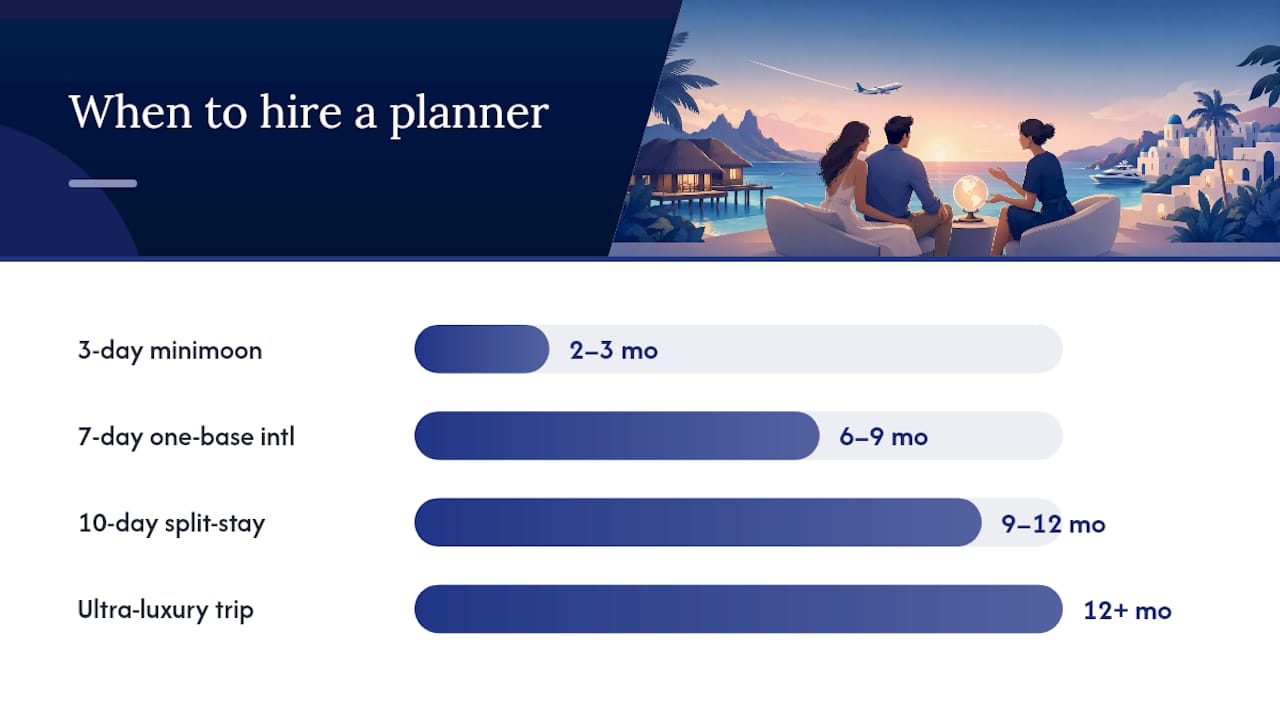
Trip typeDIY or planner?When to engage
3-day domestic minimoonDIY works wellBook 2–3 months out
7-day one-base internationalEither; planner adds value for premium rooms6–9 months out
10-day split-stay or multi-stopPlanner strongly recommended9–12 months out
Ultra-luxury (safari, Maldives, private villa)Planner essential12+ months out

When does hiring a honeymoon planner actually make sense? — overview diagram

A planner’s honest take on what most couples get wrong

Most couples spend the most energy on the destination and the least energy on the pacing. They pick Bora Bora or the Amalfi Coast, book a beautiful hotel, and then fill every day with activities because they feel like they should make the most of it. By day four, they’re exhausted and quietly resentful of the itinerary they built.

The habit I’d suggest: always schedule your highest-effort experience in the middle of the trip, not on day one or two. You need a day or two to decompress from the wedding before you’re actually present enough to enjoy a once-in-a-lifetime experience. And you need a buffer day after it so the memory isn’t immediately crowded out by another big event.

One thing most articles won’t tell you: do a quick mood check with your partner every morning. Not a formal conversation, just a simple “how are you feeling today?” That one question lets you swap a planned hike for a beach day without either person feeling like they’re ruining the plan. The couples who do this consistently report that their trip felt more like theirs.

Before you leave, hand off one specific person the responsibility for wedding-day loose ends: who has the gift envelopes, who holds the house key, who follows up with the caterer on the final invoice. One person, one handoff. Don’t let that list follow you onto the plane.


Elitetravelgroup’s bespoke honeymoon planning: how to get started

Planning a honeymoon from scratch is genuinely time-consuming, and after months of wedding logistics, most couples are ready to hand the details to someone who does this every day. Elitetravelgroup’s luxury honeymoon packages are built around a concierge model that removes the friction entirely.
Elitetravelgroup

Here’s how it works: you start with a brief intake call where the team learns your dates, budget, and two or three destination preferences. From there, they draft a custom itinerary, walk you through it, and refine it until it’s exactly right. Every booking, from European routes to Asia itineraries, is handled by the agency, with on-the-ground partners managing the details at your destination. No service fees. No guessing whether the overwater villa you found online is actually as good as the photos suggest.

To get started, gather your travel dates, a rough budget range, and two or three destination ideas. Then request a consultation at Elitetravelgroup. The team is available 24/7, so you can reach out whenever the planning urge hits, even at midnight after a rehearsal dinner.


Sources

  • Wwwnc
  • How to Plan a Honeymoon: The Complete 2026 Guide (Timeline, Budget, Destinations) | My Honeymoon Hotel
  • Honeymoon Planning 101: What You Need to Know – Zola
  • A honeymoon planning timeline | The Knot
  • Honeymoon Itinerary Planning: Your Stress-Free Guide | The Aurora Wedding

Recommended

  • Must-Have Honeymoon Itinerary Ideas for Couples in 2026
  • Honeymoon Planning Checklist: Your Full Timeline Guide
  • Luxury Honeymoon Booking: Step-by-Step Guide 2026
  • Honeymoon Planning: Your Complete 2026 Guide
August 8, 2026 0 comments
0 FacebookTwitterPinterestEmail
Hands examining cruise ship deck plan
Travel

The Role of Concierge in Cruises: Luxury Planning & 24/7 Advocacy

by Tammy Levent August 7, 2026
written by Tammy Levent

A concierge-level cruise travel adviser handles everything a luxury sailing demands: personalized itinerary design, relationship-driven access through consortium channels, and around-the-clock advocacy from first deposit to the moment you step back off the gangway. Agencies like Elite Travel Management Group, Inc. hold memberships in Virtuoso, Signature Travel Network, and Ensemble Travel Group, and carry CLIA credentials that translate directly into preferred access and standardized perks most travelers cannot secure on their own.

At a glance, a concierge-level adviser:

  • Matches your party to the right ship, itinerary, and suite using deck-plan knowledge
  • Manages dining, spa, and shore-excursion reservations within optimal booking windows
  • Integrates pre- and post-cruise flights, hotels, and private transfers
  • Monitors fares after booking and applies promotions or repricing when available
  • Acts as your single point of contact if a flight delays, a sailing changes, or a cabin needs to be swapped

Who benefits most: time-poor executives, milestone celebrations (milestone anniversaries, milestone birthdays, honeymoons), multi-generational families, and travelers with accessibility, dietary, or medical requirements.

Key Takeaways

A concierge-level cruise travel adviser delivers access, advocacy, and precision planning that direct booking cannot replicate, with no service fees and the same fare you would pay online.

PointDetails
Commission-paid modelConcierge advisers typically earn from cruise lines, so core planning services cost clients nothing beyond the fare.
Consortium perksVirtuoso, Signature, and Ensemble memberships unlock onboard credits, upgrades, and exclusive shore options unavailable to direct bookers.
Book 12–18 months outSuite inventory on popular luxury sailings moves fast; engaging a concierge early secures the best cabin options.
24/7 advocacy mattersA single point of contact during travel disruptions resolves flight delays, rebookings, and onboard issues faster than self-managing.
Elitetravelgroup35 years of experience, consortium memberships, CLIA credentials, no service fees, and a price-match guarantee for luxury cruise travelers.

Table of Contents

  • What a concierge-level cruise travel agent actually does
  • How consortium access and relationships deliver real perks
  • What concierge booking includes versus booking online
  • When to engage a concierge and how the booking timeline works
  • Which travelers get the most value from a concierge adviser
  • How to vet and choose a luxury cruise concierge
  • Elite Travel Management Group: 35 years of concierge-level cruise expertise
  • Why concierge planning matters more than most travelers realize
  • Ready to plan your luxury cruise with a concierge?
  • Sources

What a concierge-level cruise travel agent actually does

The work starts well before any deposit clears. A concierge adviser opens with a discovery conversation: preferred destinations, travel pace, cabin priorities, dietary restrictions, mobility needs, and budget range. From there, the adviser builds a shortlist of sailings that genuinely fit, not just the ones with the best commission.

Cabin selection goes deeper than category. An experienced adviser reads deck plans for noise zones (avoid cabins above the theater or below the pool deck), midship positioning for motion sensitivity, and proximity to suite-only amenities. That level of precision is what separates a concierge from a search engine.

Once a sailing is confirmed, the adviser maps every reservation window: specialty dining typically opens 90–120 days out on most luxury lines, spa bookings often follow, and popular shore excursions can sell out weeks before departure. The adviser tracks those windows and books on the client’s behalf. Pre- and post-cruise logistics, including hotel positioning the night before embarkation to eliminate missed-boarding risk, are built into the same plan.

When disruptions happen, the adviser is the single call. A delayed inbound flight, a missed port, a medical situation onboard: the concierge coordinates with the cruise line, the airline, and ground operators simultaneously rather than leaving the client to manage three separate calls from a foreign airport.

Pro Tip: Ask any prospective adviser which cruise lines they have direct contacts with at the management level, not just the reservations desk. That relationship is what gets a suite released or a dining reservation added when the system says “unavailable.”

Planning StageConcierge ActionClient Benefit
DiscoveryNeeds assessment, sailing shortlistRight ship and itinerary match
Pre-bookingDeck-plan cabin selectionOptimal placement, no noise surprises
Post-depositDining, spa, excursion reservationsPriority access within booking windows
OngoingFare monitoring, promotion applicationCost savings or added perks
Travel dayFlight, transfer, hotel coordinationSingle point of contact for disruptions

How consortium access and relationships deliver real perks

The leverage a high-volume luxury adviser carries is not abstract. Cruise lines pay commission to agents, which means the quoted fare you see online is typically the same fare your adviser books — yet the adviser can layer benefits on top that a direct booking cannot access.

Consortium membership is where that layering happens. Virtuoso, Signature Travel Network, and Ensemble Travel Group each negotiate standardized amenity packages with preferred cruise lines: onboard credits, cabin upgrades when inventory allows, welcome gifts, private shore experiences on select sailings, and occasionally reduced deposits. These are not negotiated case by case; they are standing agreements that flow automatically to clients booked through member agencies.

Beyond consortium perks, advisers with direct relationships at the cruise-line management level can access group space inventory and unpublished amenities not visible to the public. A client booking independently pays the same commission-inclusive fare but receives none of those extras.

Typical perks a concierge adviser can secure (line- and sailing-dependent):

  • Onboard credit ($100–$500 per cabin on many luxury sailings)
  • Cabin category upgrades when inventory opens
  • Priority embarkation or specialty restaurant reservations
  • Private transfers and pre-positioned hotel nights
  • Exclusive or small-group shore experiences through consortium agreements

Consortium membership signals buying power. Agencies in Virtuoso, Signature, or Ensemble have met volume and quality thresholds that cruise lines recognize — and reward with preferred access.

For readers interested in private maritime alternatives alongside a cruise, top yachting destinations offer a useful comparison point for VIP shore options.

What concierge booking includes versus booking online

Most concierge-level advisers earn through cruise-line commissions, meaning their core planning services cost the client nothing beyond the fare. Some ultra-high-end consultants charge a planning fee for fully bespoke programs, particularly for complex multi-segment voyages or world cruises. That fee, when it exists, typically reflects the depth of work involved and is disclosed upfront.

Fare parity is standard: the price you pay through an adviser usually matches the cruise line’s published rate. The difference is everything that comes with it.

Cost items clients may encounter:

  • Planning fee for ultra-complex or world-cruise itineraries (not universal)
  • Single-supplement handling for solo travelers on specific cabin categories
  • Event or celebration surcharges (private dining setups, floral arrangements)

When to engage a concierge and how the booking timeline works

Suite inventory on popular luxury sailings moves fast. For peak-season Mediterranean or Alaska departures, the best suites on small-ship luxury lines can be gone 12–18 months out. Engaging a concierge adviser 12 months or more before sailing is the standard recommendation for travelers with specific cabin or itinerary requirements.

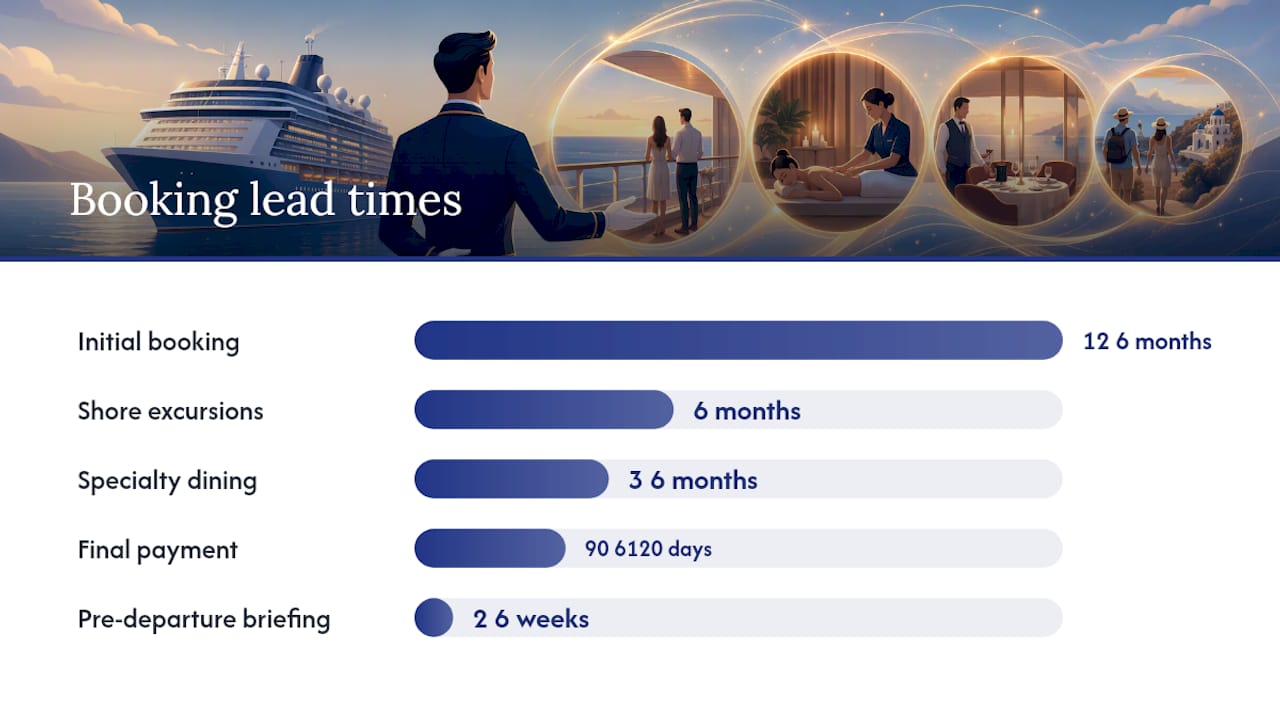
MilestoneTypical Lead TimeConcierge Action
Initial booking and deposit12–18 months before sailingSailing selection, cabin hold, deposit processing
Shore excursion reservations6 months beforeBooking opens on most luxury lines
Specialty dining reservations3–6 months beforePriority booking on client’s behalf
Final payment90–120 days before sailingPayment reminder and confirmation review
Pre-departure briefing2–4 weeks beforeDocuments, transfers, emergency contacts
Travel dayDay ofFlight monitoring, transfer coordination

The adviser also monitors for fare drops and new promotions throughout the booking window, applying savings or upgrades when the line allows. For a detailed booking walkthrough, the luxury cruise booking guide covers lead-time recommendations by sailing type.

When to engage a concierge and how the booking timeline works — overview diagram

Which travelers get the most value from a concierge adviser

The clearest candidates are travelers for whom something going wrong carries a high cost: a milestone anniversary that cannot be rescheduled, a multi-generational group where one cabin problem affects twelve people, or a traveler with medical equipment that must be pre-arranged with the ship’s medical team.

Strong fit for concierge-level cruise services:

  • Time-poor executives who cannot spend hours researching deck plans and booking windows
  • Couples celebrating anniversaries, honeymoons, or milestone birthdays
  • Multi-generational families with mixed mobility or dietary needs
  • First-time luxury cruise travelers who do not know what they do not know
  • Travelers combining a cruise with pre/post land programs in multiple countries

Likely fine booking independently: experienced cruisers repeating a familiar itinerary on a line they know well, with no special requirements and flexibility on cabin category.

On cost sensitivity: when a concierge secures even a modest onboard credit or a cabin upgrade, the financial value often offsets any planning fee. Precision planning that prevents a missed embarkation or a mismatched itinerary carries value that is harder to quantify but easy to feel.

How to vet and choose a luxury cruise concierge

Use this checklist during any adviser interview:

  1. CLIA certification — confirms formal cruise-industry training and ongoing education requirements.
  2. Consortium membership — Virtuoso, Signature Travel Network, or Ensemble signals preferred-supplier access and standardized client perks.
  3. Years of cruise-specific experience — general travel experience is not the same; ask how many luxury cruise bookings they handle annually.
  4. 24/7 support availability — a travel emergency does not wait for business hours; confirm who answers after hours and how.
  5. Direct cruise-line relationships — ask which lines they have management-level contacts with, not just reservations access.
  6. References or outcome examples — a confident adviser can describe specific situations where their intervention changed a client’s outcome.

Questions to ask directly:

  • “Can you describe a time you secured a suite upgrade or resolved a disruption for a client?”
  • “How do you handle fare drops after I’ve deposited?”
  • “Do you charge a planning fee, and under what circumstances?”
  • “Who is my point of contact if something goes wrong during travel?”

Red flags: no cruise specialization, vague answers about upgrades or held inventory, no 24/7 support, and reluctance to provide references.

Elite Travel Management Group: 35 years of concierge-level cruise expertise

Elite Travel Management Group, Inc. has spent 35 years building the relationships and credentials that make a material difference for luxury cruise travelers. The agency holds memberships in Virtuoso, Signature Travel Network, and Ensemble Travel Group, carries CLIA credentials, and operates 24/7 so clients have a real person available regardless of time zone or travel day complications.

What working with Elitetravelgroup includes:

  • Bespoke itinerary design with cabin selection based on deck plans and client priorities
  • Integrated flight, hotel, and private transfer coordination
  • Dining, spa, and shore-excursion reservations managed within optimal booking windows
  • Ongoing fare monitoring and promotion application post-deposit
  • 24/7 on-call advocacy during travel
  • No service fees and a price-match guarantee

The agency specializes in milestone events, VIP experiences, and complex multi-segment itineraries where the stakes of getting it wrong are highest. For travelers combining a cruise with European land programs, the integrated planning approach handles both segments under one contact.

Why concierge planning matters more than most travelers realize

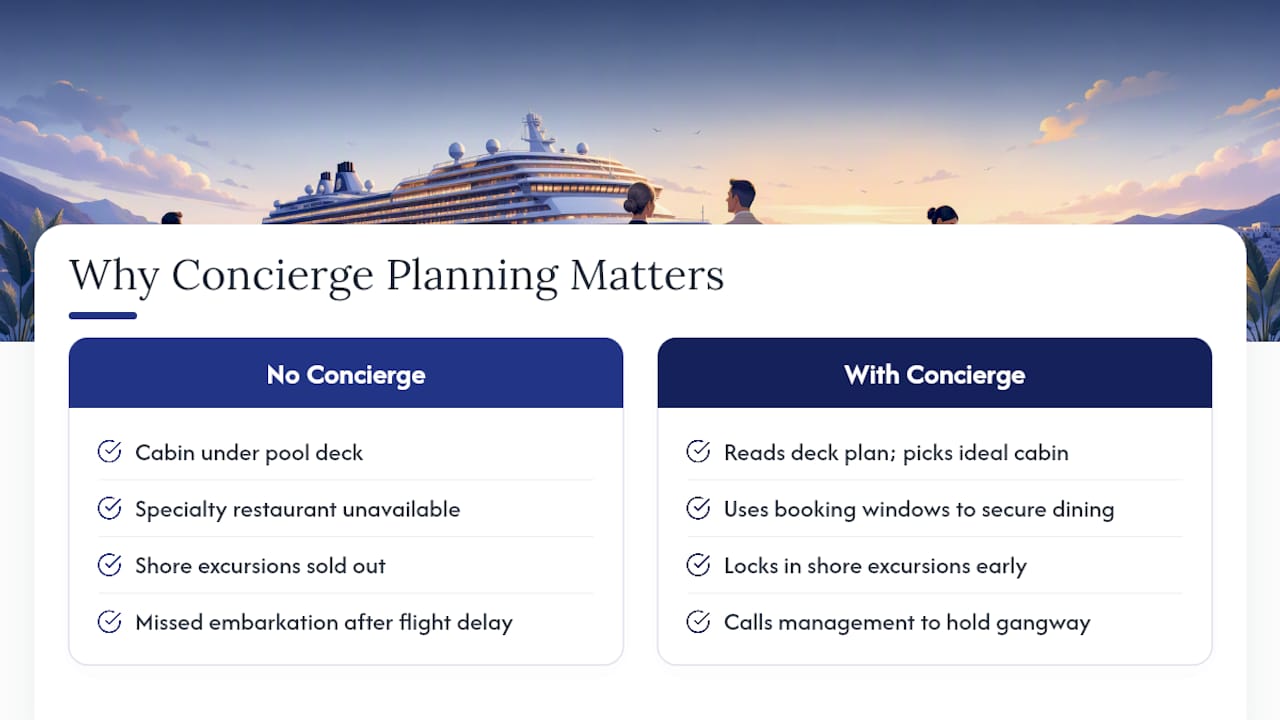
Most people underestimate how much of a luxury cruise experience is decided before the ship leaves port. The cabin you are in, the dining reservations you hold, the shore experiences you have locked in: those are not random. They are the result of someone who knew the booking windows, read the deck plan, and made the calls at the right moment.

What I have seen over decades in this work is that the travelers who feel most disappointed after a luxury sailing are almost never disappointed by the ship. They are disappointed by the cabin that turned out to be under the pool deck, the specialty restaurant they could not get into, the shore excursion that sold out before they thought to book it. A concierge does not just add perks. The concierge removes the gaps that turn a $15,000 sailing into a $15,000 lesson.

Two situations stay with me. A client who called after a flight delay threatened their embarkation: one call to the cruise line’s management contact held the gangway long enough for them to board. Another client, celebrating a 40th anniversary, arrived to find a suite upgrade and a private dinner arrangement that the line had confirmed through our consortium relationship. Neither outcome was luck.

Why concierge planning matters more than most travelers realize — overview diagram

Ready to plan your luxury cruise with a concierge?

Elitetravelgroup offers something direct booking cannot: 35 years of cruise-line relationships, consortium access through Virtuoso, Signature, and Ensemble, and a team available 24/7 with no service fees and a price-match guarantee. You pay the same fare and receive significantly more.

Elitetravelgroup

To get started, have your preferred travel dates, party size, cabin category, and any special requirements ready. Then connect with the Elitetravelgroup team for a discovery call where an adviser will match you to the right sailing, walk through the planning timeline, and begin securing your reservations. For travelers combining a cruise with an adventure travel extension, the same concierge handles both.

Sources

  • Why You Need Luxury Cruise Travel Agents – and How to Find a Good One – Cruise Critic
  • Travel Advisor vs. Booking a Cruise Online | Cruise Planners
  • Luxury cruise and tour travel agent: 2025 guide – First Travel Diary PR

Recommended

  • Role of a concierge in luxury travel planning
  • Advantages of Concierge-Level Cruising: 2026 Guide
  • Why concierge travel delivers truly exceptional luxury
  • Concierge Travel Planning Guide: Enjoy Stress-Free Luxury
August 7, 2026 0 comments
0 FacebookTwitterPinterestEmail
Planner scouting exclusive villa for wedding venue
Travel

Best Luxury Destination Wedding Planners: A Curated Guide

by Tammy Levent August 5, 2026
written by Tammy Levent


TL;DR:

  • Elitetravelgroup offers integrated travel logistics and wedding planning with no service fees and 24/7 support. It specializes in full guest travel management and multi-day guest experiences, making it ideal for couples seeking seamless coordination. Other options include boutique planners for bespoke design and resort teams for all-inclusive simplicity.

For couples who want travel logistics and wedding production handled by a single expert team, Elite Travel Management Group, Inc. is the recommended concierge-integrated pick. With decades of experience, no service fees, a price-match guarantee, and 24/7 availability, it covers everything from bespoke venue sourcing to guest flight coordination under one roof. Luxury destination wedding planning, done properly, treats the entire weekend as a multi-day guest experience, not just a ceremony with a dinner attached.

Your shortlist at a glance:

  • Elite Travel Management Group, Inc. — Best for couples who want travel and wedding planning fully integrated. One team, one contact, no gaps between the guest travel side and the event production side.
  • Boutique international couture planners (Mindy Weiss, Colin Cowie, Calder Clark, Lisa Vorce, and similar firms) — Best for couples whose priority is singular creative vision and bespoke design. These firms limit their client calendars sharply, which means deep attention but also long lead times.
  • Resort event teams / on-site coordinators — Best for couples who want a predictable all-inclusive package at a single property and are comfortable working within that venue’s vendor list.

Before your first call, have these ready: your preferred dates (plus two backup options), an estimated guest count, your top two or three destination regions, and a rough sense of your total budget ceiling.

Table of Contents

  • How do the best luxury destination wedding planners compare?
  • How we chose and rated these planner options
  • What does a luxury destination wedding planner actually do?
  • How do you choose the right luxury destination wedding planner?
  • What is the final recommendation, and what should you do next?
  • Key takeaways
  • The part most couples find out too late
  • Elitetravelgroup’s concierge destination wedding service
  • Useful sources and further reading

How do the best luxury destination wedding planners compare?

Luxury planners provide end-to-end management covering venue scouting, vendor negotiation, legal-document assistance, and guest travel concierge. The table below maps five planner types against the dimensions that matter most to affluent couples.

Comparison chart of luxury destination wedding planners

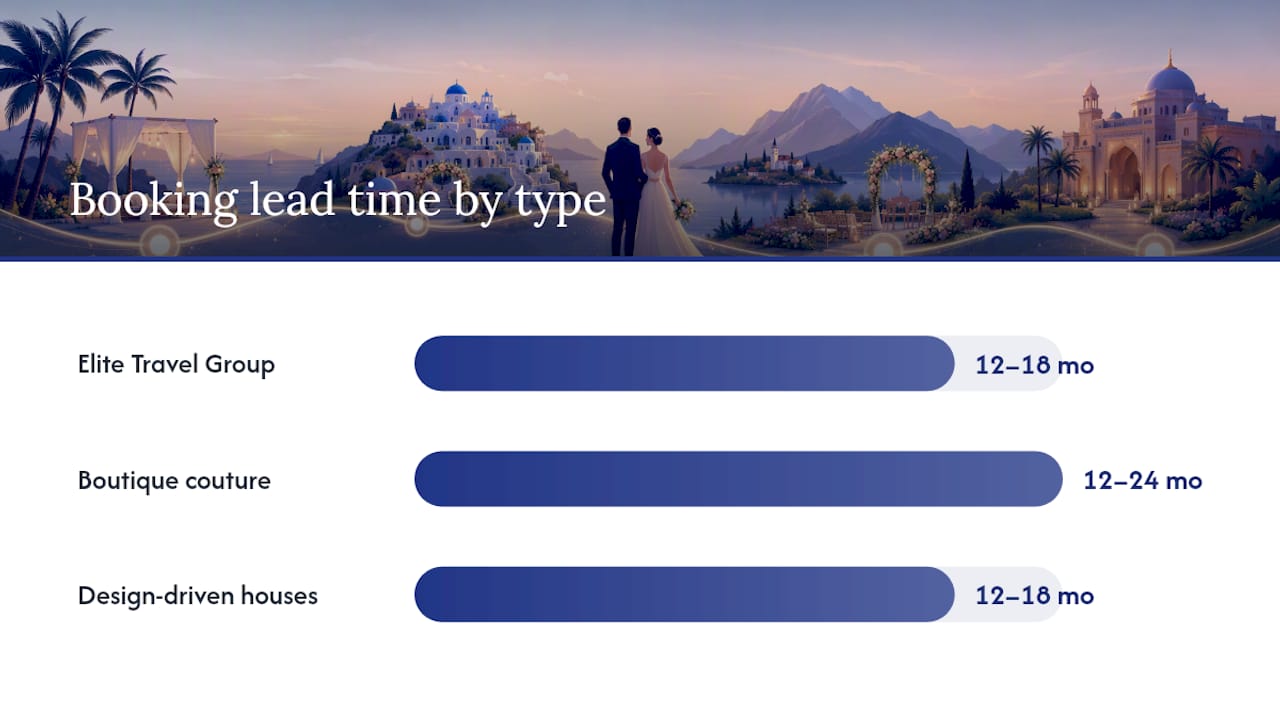
Planner TypeBest ForServices OfferedTypical Starting BudgetRegions ServedBooking Lead TimeTravel & Guest Logistics
Elite Travel Management Group, Inc.Couples wanting travel + wedding planning integratedFull-service planning, design, on-the-ground coordination, guest travel concierge, VIP accessCustom; no service fees, price-match guaranteeEurope, Caribbean, Mexico, worldwide12–18 months recommendedFull guest travel management, room blocks, concierge
Boutique international couture plannersExclusive creative design, bespoke venue curationFull-service planning, design direction, limited-client production$100,000+ bespoke productionsGlobal, planner-dependent12–24 monthsVaries; some offer guest travel coordination
Design-driven production housesLarge-scale, theatrically produced ceremoniesLarge-scale production, staging, immersive design—Major destination markets12–18 monthsLimited; typically outsourced
Resort event teams / on-site coordinatorsAll-inclusive packages, single-venue simplicityCeremony logistics, resort packages, in-house vendors—Resort destinations globally6–12 monthsRoom blocks managed by resort; limited outside vendors
Local destination specialistsSingle-country depth, cost-efficient regional logisticsOn-the-ground coordination, vendor sourcing, legal guidance—Specific country or region12–18 monthsLocal transport and vendor logistics; guest travel often separate

Boutique couture planners like Mindy Weiss, Colin Cowie, Marcy Blum, Sarah Haywood, Bash Please, Easton Events, Laurie Arons Special Events, and Calder Clark are the right call when design is the non-negotiable priority and budget is essentially open. Resort teams work when you want cost predictability and a single property to manage. The case for Elitetravelgroup is specific: if your guest list is flying in from multiple cities, you need someone who can handle the travel logistics with the same rigor as the ceremony itself, and that is where a concierge-integrated approach pays for itself.

Pro Tip: Ask every planner candidate whether guest travel management is handled in-house or referred out. If it’s referred out, you have two separate teams to coordinate, two contracts to manage, and two points of failure on the weekend itself.

How we chose and rated these planner options

Every planner type and named firm in this guide was evaluated against the same criteria. Here is exactly what qualified an entry for inclusion:

  1. Experience with luxury multi-day events. The planner or firm must have a documented track record with multi-day destination celebrations, not just single-ceremony coordination.
  2. Access to exclusive venues. Verified relationships with private estates, historic properties, or resort partners that are not available through standard booking channels.
  3. Travel and guest-management capabilities. Demonstrated ability to handle room blocks, guest flight coordination, and on-the-ground concierge, either in-house or through a named partner.
  4. Design and production depth. A portfolio showing original creative direction, not just vendor assembly.
  5. Limited-client focus. Top-tier planners intentionally limit the number of clients each year to preserve creative attention and execution quality. Firms that show no evidence of capacity limits were weighted lower.
  6. Proof points. Editorial features in recognized wedding or luxury lifestyle publications, industry awards, or verifiable press coverage.

Research sources include planner and agency websites, wedding editorial features, industry portfolio reviews, and vendor partnership disclosures. The minimum threshold for inclusion was at least two verifiable proof points (press, awards, or documented portfolio).

Disclosure: Elitetravelgroup is the publisher of this article and offers concierge destination wedding services. It is included and recommended on merit, specifically for its integrated travel-plus-wedding model, not because it is the publisher.

What does a luxury destination wedding planner actually do?

The gap between a standard planner and a luxury destination specialist is not just price. It is scope, access, and the depth of what gets managed.

Venue scouting and negotiation

A luxury planner does not send you a list of venues from a search engine. They have standing relationships with private estates, historic villas, and resort properties that never appear on public booking platforms. They negotiate contract terms, exclusivity windows, and vendor access rights, not just the date and the room rate.

Vendor sourcing and contract review

Every vendor contract at a luxury destination wedding carries clauses that can cost you significantly if you miss them: attrition penalties, force majeure terms, outside-vendor fees, and cancellation structures. A senior planner reviews all of it and negotiates addenda before you sign.

Design and production

This goes well beyond florals and table settings. At the luxury level, production includes custom lighting rigs, bespoke entertainment (live musicians, performance artists, private fireworks), branded guest touchpoints, and multi-room set changes between ceremony and reception.

Custom lighting and floral design at wedding reception

Multi-day guest experience programming

Luxury destination planning treats the wedding as a multi-day guest experience; logistics like guest transport and welcome events are as important as design. A well-structured weekend typically includes a welcome dinner or cocktail event on arrival night, curated off-site experiences on the day before the ceremony, and a farewell brunch. Each of these requires its own vendor coordination, transport logistics, and timing plan.

Guest travel and concierge

This is where most standard planners stop and where the best destination wedding experts start. Guest travel concierge covers flight recommendations, group rate negotiation, room-block management, airport transfers, and a 24/7 contact for guests who miss connections or need last-minute changes. Elitetravelgroup handles this in-house, which is the structural advantage over planners who refer it out.

On-site management

On the wedding day itself, a luxury planner has a full team on the ground: a lead coordinator, a vendor liaison, a guest-experience manager, and a troubleshooter. Problems get solved before the couple ever hears about them.

Pro Tip: When reviewing planner proposals, ask for a sample weekend itinerary, not just a day-of timeline. A planner who has only mapped the ceremony and reception has not thought through the full guest experience. The welcome event, the off-site excursion, and the farewell brunch should all appear with logistics attached.

How do you choose the right luxury destination wedding planner?

Selection is a process, not a gut feeling. Work through these steps in order.

Step 1: Build your non-negotiable list

Before you talk to a single planner, write down the three things you will not compromise on. For most couples it is one of these: a specific destination or venue type, a particular aesthetic or design direction, or full-service guest travel management. Your non-negotiables determine which planner category to prioritize.

Step 2: Vet the portfolio

A real luxury portfolio shows actual weddings, named venues, and credited photographers. Look for evidence of multi-day programming, not just ceremony and reception shots. Planners like Bash Please, Easton Events, Laurie Arons Special Events, Jove Meyer, David Stark Design, Callista & Co., Augusta Cole, The Lynden Lane Co., Julian Leaver Events, A Charming Fête, Roque Events, Moon Realm, Ashley Smith Events, Honey + Thyme, Fête NY, JZ Events, Fallon Carter Events, Exclusive Italy Weddings, Alison Bryan Destinations, Anaïs Events, Banana Split London, Beth Helmstetter, ByChenai Events, Claire Bean Events, Diwan by Design, EKS Events, Elyse Jennings Weddings, Fait Accompli, Gregory Blake Sams, HauteFêtes, Hessney & Co., Houses & Parties, In Any Event, Laurie Arons, Lauryn Prattes Events, Le Petite Privé, Lisa Vorce, Liz Linkleter Events, Masi Events, Matthew Robbins & Luis Otoya, Michelle Norwood, Charlotte Elise Weddings and Events, Alice Wilkes Design, Allegory Events, Amelia Carleton Weddings, Amy Abbott Events, Ashley Pigott Events, Azalea Events House, Best Events Co., Claire Do Monte Weddings, DestinationWeddings.com, Amorology, Wedding Erah, Apricity Event Co, Kiran + Leigh, Mandy Marie Events, Mae & Co. Creative, Chloe Alise Events, Mudari Creative, Riviera Creative, Grit & Grace, Jesse Tombs, Details, Darling, Wild Heart Events, Studio Sully, Meag Breanne Events, and Vanessa Pence all have distinct visual identities and regional strengths. Match the portfolio to your vision before you get on a call.

Step 3: Run a structured discovery call

Ask these questions directly:

  • How many weddings do you take per year, and is my date still available?
  • Who is my lead planner, and will they be on-site for the full weekend?
  • Do you handle guest travel in-house, or do you refer it out?
  • Can you share a sample vendor contract addendum and a sample weekend timeline?
  • What are your policies on outside vendors, and are there fees attached?
  • How do you handle cancellations, and what are the attrition terms on room blocks?

Red flags to walk away from

  • Vague scope of services with no written deliverables list
  • No local vendor network in your chosen destination
  • Hidden fees for bringing in outside vendors
  • Unwillingness to share sample contracts or references before signing
  • A planner who takes on more than a dozen destination weddings per year without a documented team structure

Planning timeline and budget benchmarks

Luxury venues often require booking 12–18 months in advance to secure the most exclusive dates. Build your planning calendar around that constraint.

MilestoneRecommended Lead Time
Secure venue and planner12–18 months before wedding date
Confirm legal requirements (apostilles, documents)12 months out
Negotiate room blocks12 months or more
Final guest count and catering confirmation4–6 weeks out

On budget: all-inclusive resort packages for medium-sized guest lists typically range widely in cost, while fully bespoke luxury productions start well above $100,000 and scale with imported florals, international vendor travel, and private entertainment. The biggest cost drivers are not the venue fee; they are the production elements couples add after signing.

For US couples, Mexico and the Caribbean offer the most predictable logistics because of direct flights and established resort infrastructure. Europe adds complexity but also access to venues that simply do not exist anywhere else.

One specific financial note: block rooms for a portion of expected guests to limit attrition liability while retaining group perks. To limit attrition liability while retaining group perks. Blocking 100% is a common mistake that leaves couples exposed to significant penalties if attendance drops.

What is the final recommendation, and what should you do next?

Elitetravelgroup is the strongest fit for couples who need travel logistics and wedding production managed by one team. The 24/7 availability, no-service-fee model, and in-house guest travel concierge remove the coordination gap that causes most destination wedding problems. If your priority is a specific local planner with deep roots in one country, a boutique specialist like Exclusive Italy Weddings or a local destination specialist in your chosen region may serve that narrow need better. If theatrical production scale is the goal, a design-driven production house is worth the additional coordination overhead.

For everyone else, here are your three next steps:

  1. Schedule a consult with Elitetravelgroup (or shortlist one boutique couture planner whose portfolio matches your vision). Do not shortlist more than two at this stage.
  2. Prepare your brief: confirmed or preferred dates, guest count, top two destination regions, and a written must-have list. Planners give better proposals when you give them specifics.
  3. Request sample materials: a sample weekend timeline, a sample vendor contract addendum, and two client references from weddings in your preferred region.

Booking lead time: Luxury venues book 12–18 months out. If your timeline is shorter than 12 months, tell your planner immediately. Some venues have last-minute cancellations, and an experienced planner with strong relationships can sometimes move faster, but only if they know the constraint upfront.

Key takeaways

The most important decision in luxury destination wedding planning is choosing a provider whose service scope matches your actual needs, not just your aesthetic preferences.

PointDetails
Integrate travel and wedding planningSeparate travel and event teams create coordination gaps; a single concierge provider eliminates them.
Book 12–18 months outPremium venues fill that far in advance; shorter timelines require a planner with strong existing relationships.
Block around 60–70% of roomsBlocking all guest rooms is a financial risk; around 60–70% limits your exposure to attrition penalties.
Ask for sample contractsAny planner unwilling to share sample contracts or references before signing is a red flag.
Elitetravelgroup’s advantageElitetravelgroup combines destination wedding packages with in-house guest travel concierge, no service fees, and 24/7 support.

The part most couples find out too late

The wedding industry talks constantly about design: the florals, the lighting, the tablescape. What it underplays is the operational complexity that determines whether any of that design actually lands.

The couples who have the most stressful destination weddings are almost always the ones who hired a brilliant designer and then tried to manage the travel side themselves, or handed it to a travel agent who had never worked a wedding weekend. The result is a beautiful ceremony surrounded by guests who missed connections, got put in the wrong rooms, or showed up exhausted from a logistics failure nobody caught.

The planner’s job is not just to make things beautiful. It is to make sure nothing breaks. That requires local vendor relationships built over years, not assembled from a Google search six months before the date. It requires knowing which venues have unreliable catering teams and which ones have never missed a timeline. It requires having a contact at the hotel who picks up the phone at 11 PM when a VIP guest’s room is wrong.

Limiting client loads is how the best planners protect that standard. A planner taking many weddings a year cannot give any of them the operational depth a destination event requires. When you are evaluating proposals, the number of weddings a planner takes annually is one of the most honest signals of what you will actually get.

Verify references by asking specifically about problems, not just outcomes. “What went wrong, and how did your planner handle it?” is the question that separates the planners who are good at selling from the ones who are good at executing.

Elitetravelgroup’s concierge destination wedding service

Most destination wedding planners hand off the guest travel piece to a separate agency. Elitetravelgroup does not. The destination wedding packages include in-house guest travel management alongside full event coordination, which means one team handles flight recommendations, room-block negotiation, airport transfers, and 24/7 guest concierge from the same desk that is managing your venue contract and vendor timeline.

Elitetravelgroup

The practical difference: when a guest’s connection gets canceled the morning of your welcome dinner, your planner already has the relationship with the hotel and the airline contact to fix it without pulling you away from getting ready. That is what 35 years of concierge travel experience actually looks like in practice.

What you get working with Elitetravelgroup:

  • A single point of contact for both travel logistics and wedding event planning
  • On-the-ground partners in Europe, the Caribbean, Mexico, and worldwide
  • No service fees and a price-match guarantee
  • 24/7 availability throughout the planning process and the wedding week
  • Curated multi-day guest experience design, from welcome events to farewell brunches

To get started, request an availability check and a bespoke proposal. Come with your dates, guest count, and preferred region, and Elitetravelgroup will build a plan around what you actually need.

Useful sources and further reading

A short list of authoritative resources for couples who want to verify legal requirements, timeline guidance, and planner selection criteria:

  • The Complete Destination Wedding Guide — BeachBride: Covers legal requirements by country, venue booking timelines, and all-inclusive budget benchmarks. Start here for a broad overview.
  • What Do I Need to Plan a Destination Wedding? — Teach Travel Discover: Practical checklist including room-block strategy, attrition guidance, and destination logistics for US couples.
  • How to Plan a Destination Wedding in 2026 — Wedding Inside: Covers destination selection, local planner hiring, and travel accessibility considerations.
  • Destination Wedding Checklist — Sumissura: Step-by-step checklist from budget definition through vendor booking and legal research.
  • Sarah Haywood Weddings: A working example of a limited-client luxury planner model; useful for understanding what a high-standard proposal and portfolio should look like.

Quick verification checklist for vetting any planner:

  • Portfolio shows named venues and credited photographers from actual weddings
  • References available from at least two destination weddings in your preferred region
  • Sample vendor contract addendum available before signing
  • Clear written scope of services with deliverables listed
  • Local vendor partnerships documented, not just claimed
  • Team structure disclosed (who is on-site, who is backup)
  • Cancellation and attrition terms spelled out in writing

Recommended

  • Why Hire for Destination Weddings: A Couples’ Guide
  • Destination Wedding Packages | Elite Travel
  • Types of Destination Weddings: Your Planning Guide
  • How to plan a luxury honeymoon: expert guide 2026
August 5, 2026 0 comments
0 FacebookTwitterPinterestEmail
Professional woman planning luxury travel itinerary
Travel

Best Luxury Travel Agencies 2026: Expert Rankings

by Tammy Levent August 4, 2026
written by Tammy Levent

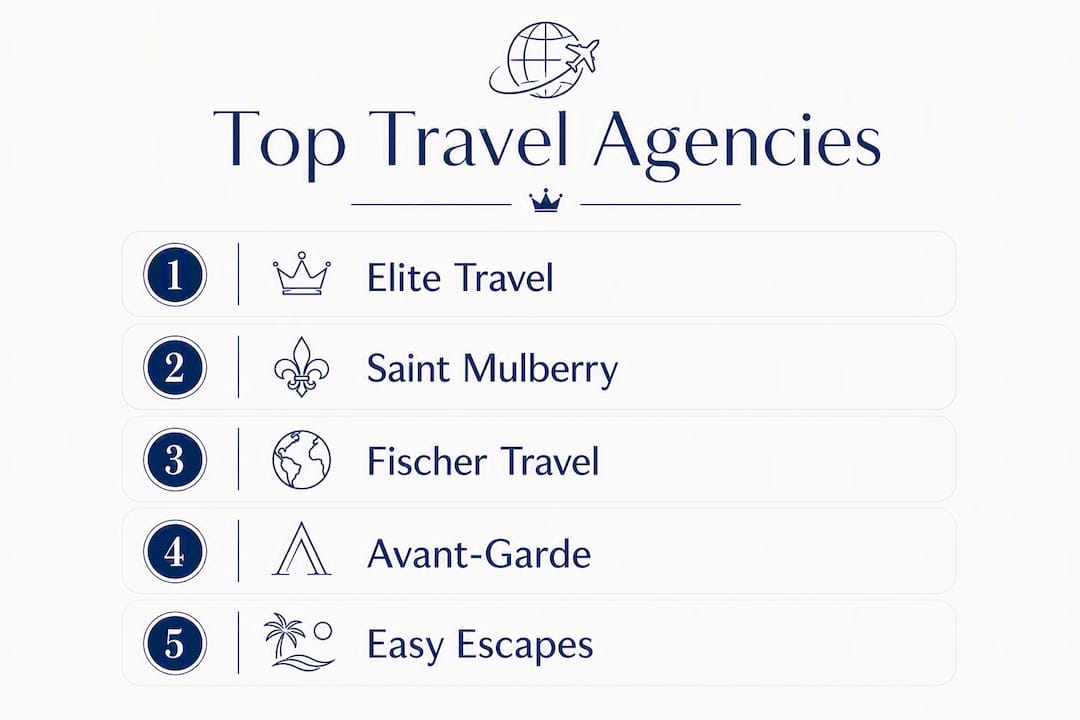
For most affluent U.S. travelers planning a bespoke trip in 2026, Elite Travel Management Group, Inc. is the strongest all-around choice. Thirty-five years of concierge-level itinerary design, zero service fees, a price-match guarantee, and genuine 24/7 operational support put it ahead of the field on the dimensions that matter most when a trip goes sideways at 2 AM in a foreign country. Travel + Leisure’s A-List Travel Advisors 2026 confirms what experienced planners already know: the most valued commodity for affluent travelers right now is the human advisor who anticipates problems before they surface, not just one who books premium products.

Quick shortlist:

  • Elite Travel Management Group, Inc. — best for bespoke milestone celebrations, Europe itineraries, and multi-country logistics
  • Saint Mulberry — best for curated boutique villa and estate travel
  • Easy Escapes Travel — best for all-inclusive luxury packages for families and couples

Table of Contents

  • 1. Best luxury travel agencies 2026: full ranked list and comparison
  • How we evaluated these agencies
  • How to choose the right luxury travel agency for your trip
  • Key Takeaways
  • Why this ranking holds up under scrutiny
  • Elite Travel Management Group, Inc. is ready to plan your 2026 trip
  • Sources used in this ranking

1. Best luxury travel agencies 2026: full ranked list and comparison

1. Elite Travel Management Group, Inc. — 9.4/10

Three and a half decades of bespoke itinerary design is not a marketing line; it is the difference between an agency that knows which Amalfi Coast villa opens its private dock in May and one that is still calling the hotel’s public reservations line. Elite Travel Management Group, Inc. charges no service fees and backs every booking with a price-match guarantee, which removes the two most common friction points affluent travelers cite when deciding whether to use an agent at all. The concierge-level VIP experience extends from the first discovery call through post-trip follow-up, with 24/7 live support that covers flight disruptions, medical emergencies, and last-minute itinerary pivots.

Quick facts:

  • Best for: Milestone celebrations, honeymoons, destination weddings, private-jet multi-country itineraries, curated group journeys, and Africa safari packages
  • Specialties: Bespoke Europe itineraries, destination weddings, VIP vacations, adventure travel, wellness retreats, luxury cruises
  • Services included: One-on-one concierge planning, 24/7 operational support, private transfers, VIP access, on-the-ground partner network
  • Geographic coverage: Europe (flagship), Africa, Asia, Middle East, worldwide
  • Credentials: Award-winning; 35 years in business; commission-based model with no client service fees

2. Saint Mulberry — 8.1/10

Client and consultant discussing luxury trip plans

Saint Mulberry occupies a specific niche: sourcing boutique villas and private estates with the kind of on-the-ground relationships that make the difference between a property that photographs well and one that actually delivers. The agency appears consistently in industry roundups for its personalized approach to villa travel, and its boutique scale means clients are not handed off to junior staff. The tradeoff is limited breadth. If your trip involves complex multi-country logistics or a destination outside its core villa network, you will feel the edges of that specialization.

Quick facts:

  • Best for: Boutique villa and private estate travel
  • Specialties: Villa sourcing, personalized on-the-ground relationships
  • Services included: Personalized planning, villa curation
  • Geographic coverage: Villa-focused; specific regions not publicly listed
  • Credentials: Profiled in industry roundups; boutique model

3. Fischer Travel — 7.8/10

Young woman researching exclusive luxury travel spots

Fischer Travel has built its reputation on multigenerational and large-group logistics, the kind of trip where you need someone who has already solved the problem of booking eight connecting suites in a single villa complex and coordinating private transfers for fourteen people across three airports. That operational experience is real and hard to replicate. The agency is less prominent in editorial lists for solo or couples travel, and its model skews toward clients who need scale managed rather than intimate bespoke design.

Quick facts:

  • Best for: Family luxury travel and large-group logistics
  • Specialties: Multi-suite villa coordination, multigenerational trip logistics
  • Services included: Group logistics, villa coordination, private transfers
  • Geographic coverage: Not publicly specified; strong villa and resort network
  • Credentials: Referenced in editorial lists for high-end family packages; longstanding firm

4. Avant-Garde Travel — 7.3/10

Avant-Garde Travel’s differentiator is narrative. Where most agencies build an itinerary around a destination, Avant-Garde builds it around a concept: a trip designed around a specific art movement, a culinary tradition, or a historical arc. That approach produces genuinely memorable experiences for travelers who find standard luxury itineraries interchangeable. It is a narrower value proposition, and clients who prioritize operational depth and 24/7 recovery support over creative program design may find the fit imperfect.

Quick facts:

  • Best for: Bespoke creative concepts and high-design experiences
  • Specialties: Narrative-driven trips, creative program design
  • Services included: Bespoke itinerary design, creative concept development
  • Geographic coverage: Not publicly specified
  • Credentials: Appears in SERP consensus for design-forward travel

5. Easy Escapes Travel — 7.0/10

Easy Escapes Travel focuses on packaged luxury, specifically all-inclusive and semi-inclusive formats for families and couples who want the premium experience without the complexity of building a trip from scratch. The operational simplicity is the point. For travelers who know exactly what they want (a luxury resort, a curated Caribbean itinerary, a family-friendly all-inclusive) and do not need a fully custom architecture, Easy Escapes delivers that efficiently.

Quick facts:

  • Best for: All-inclusive luxury packages for families and couples
  • Specialties: Packaged luxury getaways, family-friendly all-inclusives
  • Services included: Package curation, booking support
  • Geographic coverage: Caribbean and resort destinations (primary)
  • Credentials: Referenced in SERP previews for luxury family travel

Side-by-side comparison

Infographic ranking top luxury travel agencies

AgencyBest forSpecialtiesPrice band (per person)Services includedGeographic coverageCredentials / yearsContact / booking
Elite Travel Management Group, Inc.Milestone celebrations, Europe, multi-country logisticsBespoke itineraries, destination weddings, VIP vacations, adventure, cruises$8K–$50K+ pp/weekConcierge, 24/7 support, private transfers, VIP accessEurope (flagship), Africa, Asia, Middle East, worldwideAward-winning; 35 yearsDirect inquiry via website; discovery call
Saint MulberryBoutique villa and estate travelVilla sourcing, on-the-ground relationshipsNot publicly listedPersonalized planning, villa curationVilla-focused; specific regions not listedIndustry roundup features; boutiqueVia website
Fischer TravelFamily luxury and large-group logisticsMulti-suite villa coordination, multigenerational logisticsNot publicly listedGroup logistics, villa coordination, private transfersNot publicly specifiedEditorial lists; longstanding firmVia website
Avant-Garde TravelBespoke creative and high-design experiencesNarrative-driven trips, creative program designNot publicly listedBespoke design, creative conceptsNot publicly specifiedSERP consensus; design-forwardNot publicly listed
Easy Escapes TravelAll-inclusive luxury for families and couplesPackaged luxury, family-friendly all-inclusivesNot publicly listedPackage curation, booking supportCaribbean and resort destinationsSERP consensus; family luxuryNot publicly listed

On price bands: Uncompromised Travel’s 2026 Luxury Tour Operator Power Rankings benchmarks Tier 1 operators at $8,000–$50,000+ per person per week. That range reflects the genuine spread across trip types: a curated European city itinerary sits at the lower end, while a private-jet multi-country expedition or an estate-level safari pushes well past $20,000 per person. The right frame is not “how do I spend less?” but “what does this level of access actually cost to deliver properly?”


How we evaluated these agencies

The ranking used a weighted scoring framework across six criteria. No single axis dominates; the weights reflect what actually separates a good luxury agency from a great one when a trip is under pressure.

CriterionWeightEvidence type
Concierge and 24/7 operational support—Published service descriptions, editorial reviews
Exclusivity and access20%Robb Report Travel Masters of Luxury 2026, industry profiles
Customization depth20%Sample itineraries, editorial advisor profiles
On-the-ground network and recovery capability—Travel + Leisure A-List 2026, Spear’s index
Client service and documentation10%Public records, editorial interviews
Price transparency10%Uncompromised Travel 2026 Power Rankings

Data sources used: editorial research, Travel + Leisure A-List 2026, Spear’s luxury travel adviser index, Uncompromised Travel Power Rankings, Robb Report Travel Masters of Luxury 2026, published awards records, and public agency profiles.

Evaluation workflow:

  1. Research: Compile agency profiles from editorial lists, SERP consensus, and published awards
  2. Scoring: Apply the weighted framework above to each agency based on available public evidence
  3. Editorial review: Cross-check scores against real service descriptions and geographic coverage claims
  4. Final verification: Confirm contact and booking processes; flag any cells where data is not publicly available

Conflict-of-interest disclosure: This article is published by Elite Travel Management Group, Inc. Their own offering is included in the comparison and ranked first based on the defined criteria. Scores for all agencies reflect the same framework applied consistently.


How to choose the right luxury travel agency for your trip

The single most reliable rule: choose the agency whose core competency matches your trip goal. A firm that excels at multigenerational villa logistics will not automatically excel at a narrative-driven solo expedition through Central Asia, and vice versa. Operators that specialize consistently outperform generalists for the trip types they know deeply.

10-step checklist for choosing an agency:

  1. Define your purpose and non-negotiables. Honeymoon, safari, destination wedding, multi-country expedition? Write down the three things that cannot go wrong.
  2. Request sample itineraries. A strong agency produces bespoke itinerary examples without hesitation. Vague “we customize everything” answers are a warning sign.
  3. Verify 24/7 operational support. Ask specifically: who answers at 3 AM in Lisbon when your connection is canceled? Get a name or a direct line, not a general promise.
  4. Ask for references and case studies. Specifically for your trip type. A family safari reference does not validate a destination wedding capability.
  5. Check supplier relationships. Does the agency have direct contracts with hotels and operators, or is it booking through a wholesaler? Direct relationships mean better rates and faster problem resolution.
  6. Understand fees and price-match policies. Some top advisers charge retainers or limit client rosters, as Spear’s documents for ultra-high-net-worth service models. Know what you are paying for before the first call.
  7. Review the planning timeline. Bespoke trips typically require 3–6 months of lead time; complex multi-country or expedition itineraries often need 9–12 months.
  8. Read contract and cancellation terms carefully. Force majeure clauses, deposit schedules, and refund timelines vary significantly.
  9. Ask about travel insurance recommendations. A credible agency recommends specific policies for your trip profile, not a generic “you should get insurance.”
  10. Set a communication cadence. Weekly updates? Milestone check-ins? Agree on this upfront so neither side is guessing.

Questions to ask in your discovery call:

  • What is your direct supplier relationship in [destination]?
  • Who handles operational emergencies, and what is the escalation path?
  • Can you show me a comparable itinerary you have built in the last 12 months?
  • What is your cancellation and refund policy if a supplier fails?

Five red flags that suggest an agency is not ready for ultra-high-net-worth clients:

  • No named point of contact for after-hours emergencies
  • Inability to produce a sample itinerary for your trip type
  • Vague answers about supplier relationships (“we work with all the best hotels”)
  • No clear fee or commission disclosure
  • Pressure to book before you have seen a full proposal

Pro Tip: Ask the agency to sketch a single-day logistics plan for the most complex transit in your proposed itinerary. How they handle that one day reveals their sequencing ability, supplier access, and contingency thinking far better than any sales conversation.

Typical planning timeline for a bespoke luxury trip runs 3–6 months for most European and Caribbean itineraries. Multi-country expeditions, private-jet programs, and destination weddings routinely require 9–12 months, particularly for peak-season dates at properties with limited availability.


Key Takeaways

Elite Travel Management Group, Inc. leads the 2026 ranking because its 35 years of bespoke design, 24/7 operational support, and no-fee model address the three criteria that matter most when a high-stakes trip is on the line.

PointDetails
Top pick for 2026Elite Travel Management Group, Inc. scores highest on concierge depth, customization, and 24/7 support across all trip types.
Match agency to trip goalChoose the firm whose core competency fits your specific trip: villa travel, family logistics, creative design, or full-service bespoke.
Expect a broad price range per person, with Tier 1 luxury operators typically charging $8,000–$50,000+ per week; complex expeditions push higher.
Verify these trust signalsConfirm 24/7 live support, direct supplier relationships, industry affiliations, and a clear fee structure before signing.
Elitetravelgroup’s advantageNo service fees, price-match guarantee, and 35 years of bespoke itinerary design make it the strongest fit for most affluent U.S. travelers.

Why this ranking holds up under scrutiny

The agencies on this list were not chosen because they appear in the most editorial roundups. They were chosen because each one represents a distinct, defensible approach to luxury travel, and because the differences between them are real enough to matter when you are planning a $30,000 trip.

What the conventional wisdom on luxury travel agencies gets wrong is the assumption that more options mean better outcomes. The Spear’s 2026 luxury travel index documents something more interesting: the firms operating at the highest level often limit their client rosters deliberately. That is not exclusivity theater. It is a structural requirement for the kind of anticipatory, friction-free service that defines true luxury in 2026. An advisor managing 200 active clients cannot know that you prefer a corner suite with a north-facing view and that you will not eat at a restaurant that requires a jacket. An advisor managing 40 can.

The implication for how you choose is direct: do not optimize for the agency with the most impressive website or the longest award list. Optimize for the one that has the bandwidth to actually know you. That is what separates a trip that goes smoothly from one that becomes a story you tell for years, and it is the reason Elite Travel Management Group, Inc.’s model, built around dedicated concierge relationships rather than volume, earns its position at the top of this list.

The 2026 trends toward personalized, immersive journeys reinforce this. Affluent travelers are not asking for more options. They are asking for fewer, better ones, curated by someone who already knows the difference.


Elite Travel Management Group, Inc. is ready to plan your 2026 trip

Elite Travel Management Group, Inc. is the right partner for affluent travelers who want a bespoke itinerary built around their specific goals, not a packaged product with their name on it. No service fees. A price-match guarantee. And a team available around the clock, because the best trips rarely follow a 9-to-5 schedule.

Elitetravelgroup

The clients who get the most from Elite Travel tend to share a few characteristics: they are planning a milestone (a honeymoon, a significant anniversary, a destination wedding), a complex multi-country itinerary, a multigenerational family safari, or a private-jet expedition that requires genuine logistics expertise. They want one expert who knows the destination, knows the right suppliers, and will pick up the phone at any hour.

Specific services include Europe vacation packages, adventure travel expeditions, destination weddings, VIP vacations, curated group journeys, luxury cruises, and wellness retreats. View bespoke itinerary examples to see the depth of planning that goes into each trip, then reach out directly to start your discovery call.


Sources used in this ranking

  • 2026 Luxury Tour Operator Power Rankings | Uncompromised Travel — price-band benchmarks ($8K–$50K+ pp/week) and Tier 1 operator scoring used in the comparison table and price callout.
  • Travel + Leisure A-List Travel Advisors 2026 — editorial advisor profiles and commentary on the value of human advisory service; used in methodology and selection criteria.
  • The best luxury travel advisers in 2026 | Spear’s — profiles of retainer and membership models for ultra-high-net-worth clients; used in the how-to-choose checklist and fee structure guidance.
  • Travel Masters of Luxury 2026 | Robb Report — service examples (private orchestras, estate-level villa sourcing) and editorial vetting standards; used to support exclusivity and access scoring.
  • The best luxury travel companies in 2026 | Spear’s — Spear’s Travel Index profiles of top firms operating at the highest hospitality level; used in the perspective section.

Recommended

  • Top 6 elite-travel-agency.com Alternatives 2026
  • Top 6 Elite Escapes Travel Agency Alternatives 2026
  • How travel agencies elevate VIP luxury experiences in 2026
  • Top 6 luxuryvacationstravelgroup.com Alternatives Agencies 2026
August 4, 2026 0 comments
0 FacebookTwitterPinterestEmail
Couple enjoying romantic luxury cruise deck at sunset
Travel

Top Luxury Cruises for Couples: 2026 Expert Picks

by Tammy Levent August 3, 2026
written by Tammy Levent

For couples ready to stop scrolling and start planning, the top luxury cruises for couples in 2026 come down to a short list of lines that consistently deliver privacy, genuine service, and the kind of uninterrupted time together that a regular resort simply can’t replicate. Elite Travel Management Group, Inc. is the recommended booking path for milestone and honeymoon sailings, handling suite selection, private-dining arrangements, and 24/7 support so nothing falls through the cracks. The standout cruise lines to consider:

  • Regent Seven Seas Cruises — best for couples who want everything bundled, no surprises at checkout
  • Seabourn — best for food-obsessed couples on small, intimate ships
  • Viking Ocean Cruises — best for destination-first couples who want included shore excursions
  • Silversea Cruises — best for all-suite, butler-service luxury with expedition options
  • The Ritz-Carlton Yacht Collection — best for couples who want hotel-grade service at sea
  • SeaDream Yacht Club — best for yacht-style privacy and access to ports larger ships can’t reach
  • Paul Gauguin Cruises — best for a secluded tropical escape in French Polynesia
  • Virgin Voyages — best for adults-only couples who want modern design and included dining
  • AmaWaterways — best for culinary-focused couples on European rivers
  • Uniworld Boutique River Cruises — best for boutique-hotel ambiance on river itineraries
  • Ponant — best for small-ship expedition style with a refined European sensibility
  • Explora Journeys — best for modern design-forward luxury with spacious suites

Selection criteria: service-to-guest ratio, privacy features (balcony suites, private dining), all-inclusive value, ship scale, and whether the line’s signature experiences genuinely suit a couple rather than a family or group.

Table of Contents

  • What makes a luxury cruise genuinely romantic for couples?
  • How do the top luxury cruise options compare for couples?
  • Profiles: which cruise line is right for your relationship?
  • How to choose the right luxury cruise for your travel style
  • Should you book direct or hire a luxury travel advisor?
  • Practical planning checklist before your luxury cruise
  • Key Takeaways
  • A travel advisor’s perspective on romantic cruise planning
  • Plan your romantic cruise with Elitetravelgroup
  • Useful sources and further reading

What makes a luxury cruise genuinely romantic for couples?

The short answer: fewer people, more attention, and space that feels designed for two rather than for a crowd. But the specifics matter more than the marketing language.

Privacy is the first filter. A ship carrying 700 guests delivers a fundamentally different experience than one carrying 3,000, even if both use the word “luxury.” Smaller guest counts mean quieter decks, shorter waits at the spa, and the realistic possibility of a private corner at dinner. According to CruiseWatch, a high staff-to-guest ratio is one of the most practical metrics for identifying true concierge-level attention — lines advertising near 1:1 service deliver materially different experiences than larger ships relying on service pools.
Balcony suites and private dining rank consistently among the features couples value most. Private balcony dining is an increasingly bookable upgrade on many luxury lines, and the difference between a restaurant dinner and a private terrace meal with the ocean in front of you is not subtle. Lines that publish this as a formal, recurring offering tend to deliver restaurant-quality food on the terrace rather than a reheated room-service tray.

Shore experiences matter too, especially for couples who want memories beyond the ship. Small-yacht lines can access intimate ports like St. Barts, Saba, and Bequia that larger ships simply cannot reach, turning a port call into something genuinely private. Included shore excursions, where offered, remove the friction of planning and let couples focus on the experience itself.

Young women at luxury yacht shore excursion dock

The difference between small-yacht intimacy and large-ship amenities is real. A yacht-scale ship (under 300 guests) offers quiet, exclusivity, and port access. A larger luxury ship (600–1,000 guests) offers more dining venues, a bigger spa, and more entertainment variety. Neither is wrong; the right choice depends on what the couple actually wants from the trip.

Pro Tip: For honeymoons and anniversaries, luxury cruises built around milestone celebrations reward specific suite selection. Reserve a named suite or balcony cabin midship on decks 9–12 rather than booking a guarantee cabin. Midship placement reduces motion, cuts noise from engines and anchors, and typically offers better sightlines. On a milestone trip, this is not a detail to leave to chance.

Infographic showing key luxury cruise statistics for couples

How do the top luxury cruise options compare for couples?

The table below covers the primary decision dimensions. Price ranges are sample starting points for per-person, per-night rates in standard suite or balcony categories and are not guaranteed fares; actual pricing varies by itinerary, season, and cabin category.

Cruise LineBest ForAll-Inclusive LevelShip SizeSignature Romantic PerkSample Price Range (per person/night)Sample ItinerariesService Level
Elite Travel Management Group, Inc.Couples wanting a fully curated, concierge-managed bookingFull concierge service across all lines; no service feesWorks across all ship sizesBespoke private-dining arrangements, suite upgrades, 24/7 supportVaries by cruise bookedAny itinerary, worldwideDedicated advisor, 24/7
Regent Seven SeasAll-inclusive suite luxury, no surprise extrasVery high — flights, excursions, dining, drinks, gratuities includedMid-size luxury (around 700 guests)Included premium shore excursions, butler serviceFrom ~$700/person/nightMediterranean, Alaska, CaribbeanNear 1:1
SeabournFood-focused couples, small-ship explorationHigh — dining, drinks, gratuities includedSmall luxury (450–600 guests)Gourmet dining programs, expedition-capable shipsFrom ~$500/person/nightAntarctica, Norway, MediterraneanNear 1:1
Viking Ocean CruisesDestination-first couples, cultural immersionStrong — shore excursions, dining, Wi-Fi includedMid-size (930 guests)Included cultural shore programsFrom ~$350/person/nightScandinavia, Mediterranean, AsiaHigh
Silversea CruisesAll-suite butler service, expedition optionsHigh — all-suite, butler, drinks, gratuitiesSmall luxury to expedition (300–600 guests)Butler service, expedition landingsFrom ~$600/person/nightArctic, Galápagos, MediterraneanNear 1:1
The Ritz-Carlton Yacht CollectionHotel-quality service at seaHigh — dining, drinks, gratuities includedSmall yacht (298 guests)Hotel-standard suite service, private yacht scaleFrom ~$700/person/nightCaribbean, Mediterranean, EuropeNear 1:1
SeaDream Yacht ClubYacht privacy, exclusive small portsHigh — all-inclusiveYacht (112 guests)Access to St. Barts, Saba, Bequia; private beach clubsFrom ~$500/person/nightCaribbean, MediterraneanNear 1:1
Paul Gauguin CruisesSecluded tropical itinerariesHigh — drinks, excursions includedSmall yacht (332 guests)Private island access, French Polynesian exclusivityFrom ~$500/person/nightTahiti, Bora Bora, FijiHigh
Oceania CruisesCulinary focus, refined mid-size shipsMid-high — dining, some excursionsMid-size (1,200 guests)Chef-driven dining venues, culinary programsFrom ~$300/person/nightMediterranean, Caribbean, AsiaHigh
AmaWaterwaysCulinary couples, European river cruisesHigh — dining, drinks, excursions includedRiver ship (150–160 guests)La Confrérie de la Chaîne des Rôtisseurs culinary recognitionFrom ~$350/person/nightDanube, Rhine, MekongHigh
Uniworld Boutique River CruisesBoutique-hotel river experienceHigh — all-inclusiveRiver ship (120–130 guests)Designer interiors, curated shore experiencesFrom ~$400/person/nightRhine, Seine, DouroHigh
Virgin VoyagesAdults-only couples, modern designHigh — all dining included, drinks packages availableMid-size adults-only (around 930 guests)18+ sailings, modern nightlife, inclusive diningFrom ~$150/person/nightCaribbean, MediterraneanModerate-high
Crystal Cruises / Crystal EspritClassical luxury entertainment, boutique yachtHigh — dining, drinks, gratuitiesSmall yacht to small luxury (100–700 guests)High-end entertainment, Crystal Esprit yacht itinerariesFrom ~$450/person/nightCaribbean, Mediterranean, AsiaNear 1:1
PonantSmall-ship expedition, European styleHigh — dining, drinks, excursionsSmall expedition (184–264 guests)French-led service, polar and expedition accessFrom ~$500/person/nightAntarctica, Arctic, Pacific IslandsNear 1:1
Explora JourneysModern design-forward luxury, spacious suitesHigh — dining, drinks, Wi-Fi includedMid-size luxury (900 guests)Large suites, multiple pools and restaurantsFrom ~$400/person/nightMediterranean, Caribbean, Northern EuropeHigh
Scenic CruisesHigh-touch river or small-ship oceanVery high — butler service, all-inclusiveRiver ship / small ocean (150–160 guests)Butler service, tightly curated itinerariesFrom ~$450/person/nightDanube, Rhine, KimberleyNear 1:1
Tauck CruisesFully guided, cultural-depth excursionsHigh — guided excursions, dining, drinksRiver and small ocean (130–600 guests)Curated shore programming, expert guidesFrom ~$400/person/nightEuropean rivers, MediterraneanHigh
Atlas Ocean VoyagesAdventure-seeking couples, expedition luxuryHigh — dining, drinks, excursionsSmall expedition (196 guests)Expedition landings, upscale onboard amenitiesFrom ~$350/person/nightAntarctica, Arctic, AmazonHigh

A note on price: Nearly 70% of couples surveyed said they don’t travel enough together as a pair. Luxury cruise packages, particularly all-inclusive lines, often represent strong value once bundled inclusions are factored in against the cost of a comparable land-based resort with equivalent service.

Profiles: which cruise line is right for your relationship?

Elite Travel Management Group, Inc.

Before choosing a ship, consider how you’re booking it. Elite Travel Management Group, Inc. is not a cruise line but the concierge layer that makes any of the lines above work harder for you. With 35 years of bespoke itinerary experience, no service fees, and a price-match guarantee, the agency handles suite selection, private-dining pre-arrangements, celebration amenities, and 24/7 support from departure to return. For milestone trips — honeymoons, anniversaries, significant birthdays — having a dedicated advisor who already knows which cabin on which deck to request is worth more than most couples realize until something goes wrong without one.

Regent Seven Seas Cruises

The most genuinely all-inclusive line on this list. Flights, shore excursions, specialty dining, premium drinks, gratuities, and pre-cruise hotel nights are typically bundled into the fare, which means couples arrive with almost nothing left to pay for. The ships carry around 700 guests, which keeps the atmosphere intimate without sacrificing amenity variety. A Mediterranean sailing from Monte Carlo to Athens, with included excursions to Pompeii and Santorini, is a representative itinerary.

  • Best for: Couples who want zero billing surprises
  • Signature perk: Included premium shore excursions and butler service in suites
  • Ship scale: Mid-size luxury

Seabourn

Seabourn’s culinary credentials are genuine. The line has partnered with the James Beard Foundation and runs chef-driven dining programs that go well beyond standard cruise fare. Ships carry 450–600 guests and are expedition-capable, meaning a couple can sail Norway’s fjords or the Antarctic Peninsula without switching lines. The intimate scale means staff learn names quickly.

  • Best for: Food-focused couples who also want expedition access
  • Signature perk: Gourmet dining programs; expedition-capable small ships
  • Sample route: Norwegian fjords or Patagonia

Viking Ocean Cruises

Viking’s ships are adult-only by design (no children under 18), which already filters the onboard atmosphere. Shore excursions are included in the base fare, and the programming leans heavily toward cultural immersion — lectures, local performances, and guided site visits rather than poolside entertainment. The ships carry around 930 guests, making them mid-size but still manageable.

  • Best for: Couples who prioritize destinations over onboard spectacle
  • Signature perk: Included cultural shore programs
  • Sample route: Scandinavia’s fjords or Japan’s coastal cities

Silversea Cruises

Every cabin on Silversea is a suite, and butler service is standard on most ships. The line also operates one of the strongest expedition programs afloat, with the Silver Ray and similar vessels combining all-suite accommodations with Zodiac landings in the Galápagos or Arctic. For couples who want top-tier suites and the option to go somewhere genuinely remote, Silversea covers both.

  • Best for: Couples who want butler service and expedition access in the same booking
  • Signature perk: 100% suite accommodations, butler service, expedition landings
  • Sample route: Galápagos Islands or Arctic Norway

Pro Tip: When booking Silversea or any all-suite expedition line, ask your advisor about exclusive cruise experiences like private Zodiac excursions or onboard celebration setups. These are often available as pre-bookable add-ons rather than spontaneous requests, and lines that publish them formally tend to deliver them properly.

The Ritz-Carlton Yacht Collection

The premise here is straightforward: Ritz-Carlton hotel service standards translated to a 298-guest yacht. The ships are small enough to dock in ports that larger vessels skip, and the service ethos carries the same “whatever you want, whenever you want” approach that defines the hotel brand. Couples who already trust Ritz-Carlton on land will find the transition to sea intuitive.

  • Best for: Couples who want hotel-quality service in a yacht environment
  • Signature perk: Hotel-standard suite service, intimate port access
  • Sample route: Mediterranean or Caribbean

SeaDream Yacht Club

SeaDream operates two ships, each carrying just 112 guests. That scale allows access to ports like St. Barts, Saba, and Bequia that no larger ship can reach, and the onboard culture is deliberately casual luxury rather than formal. Couples get private beach clubs, Balinese daybeds on deck, and the kind of quiet that simply isn’t possible on a ship ten times the size.

  • Best for: Couples seeking genuine privacy and yacht-style itineraries
  • Signature perk: Exclusive small-port access, private beach clubs
  • Sample route: Caribbean Windward Islands

Paul Gauguin Cruises

Paul Gauguin is the specialist for French Polynesia. The line’s flagship ship has sailed these waters for decades and carries 332 guests to Bora Bora, Moorea, the Tuamotus, and Fiji. Private island access and a relaxed, tropical pace make it a natural fit for honeymoons. The all-inclusive structure covers drinks and most excursions.

  • Best for: Couples seeking a secluded tropical escape
  • Signature perk: Private island access, French Polynesian exclusivity
  • Sample route: Tahiti to Bora Bora to the Tuamotus

Oceania Cruises

Oceania’s identity is built around food. The line operates multiple specialty restaurants per ship and has developed culinary partnerships that give the dining program genuine depth. Ships carry around 1,200 guests, which is larger than most on this list, but the onboard atmosphere stays refined. The price point is lower than the ultra-luxury tier, making it a strong entry point for couples new to premium ocean cruising.

  • Best for: Couples who value food and refined public spaces at a premium (not ultra-luxury) price
  • Signature perk: Chef-driven dining venues, culinary programming
  • Sample route: Mediterranean or Asia

AmaWaterways

AmaWaterways has earned recognition from La Confrérie de la Chaîne des Rôtisseurs for culinary excellence, which is a meaningful credential in the river-cruise space. Ships carry 150–160 guests along the Danube, Rhine, Mekong, and other routes, with dining, drinks, and excursions included. For couples who want a boutique river experience with serious food credentials, AmaWaterways is the strongest option.

  • Best for: Culinary-focused couples and river-cruise first-timers
  • Signature perk: Culinary recognition, gourmet river dining
  • Sample route: Danube from Budapest to Nuremberg

Uniworld Boutique River Cruises

Uniworld ships are designed to feel like floating boutique hotels, with individually decorated interiors and a guest count of 120–130 per vessel. Shore experiences are curated rather than generic, and the all-inclusive structure covers most of what couples will want. The Seine itinerary from Paris to Normandy is a perennial favorite for anniversary travelers.

  • Best for: Couples who want a hotel-like river experience
  • Signature perk: Designer interiors, curated shore experiences
  • Sample route: Paris to Normandy or Bordeaux wine country

Virgin Voyages

Virgin Voyages operates adults-only ships with a modern, design-forward aesthetic and all dining included in the base fare. The onboard culture skews younger and more social than most luxury lines, with a nightlife program and entertainment lineup that suits couples who want energy as much as relaxation. The Caribbean and Mediterranean itineraries are the core offering.

  • Best for: Younger adults-only couples who want contemporary nightlife and inclusive dining
  • Signature perk: 18+ sailings, included dining, modern onboard culture
  • Sample route: Caribbean or Mediterranean

Crystal Cruises / Crystal Esprit

Crystal’s return to sailing brought back the brand’s reputation for high-end entertainment programming and refined onboard culture. Crystal Esprit, the line’s small yacht, carries around 62 guests and accesses ports in the Adriatic and Caribbean that the larger Crystal ships cannot. Couples who want classical luxury with genuine entertainment depth will find Crystal a strong fit.

  • Best for: Couples who want classical luxury entertainment and boutique-yacht options
  • Signature perk: High-end entertainment programs, Crystal Esprit yacht itineraries
  • Sample route: Adriatic coast or Caribbean

Tauck Cruises

Tauck’s differentiator is the quality of its guided shore programming. Every excursion is included and led by Tauck’s own guides rather than third-party operators, which produces a noticeably more curated experience. The line operates both river and ocean programs, and the guest counts stay small enough to feel personal.

  • Best for: Couples who want cultural depth and fully guided experiences
  • Signature perk: Curated shore programming, expert-led excursions
  • Sample route: European rivers or Mediterranean

Ponant

Ponant brings a French aesthetic to small-ship expedition cruising. Ships carry 184–264 guests and access polar and remote itineraries that most luxury lines don’t touch. The onboard style is refined without being stiff, and the expedition programming is genuinely serious. For couples who want to see the Antarctic Peninsula or the Pacific Islands with a luxury service standard, Ponant is one of very few options that delivers both.

  • Best for: Couples seeking expedition experiences with European style
  • Signature perk: Small-ship expedition expertise, refined French service
  • Sample route: Antarctica or French Polynesia

Explora Journeys

Explora Journeys is the newest name on this list and has built its identity around spacious suites, multiple pools, and a broad restaurant lineup. The ships carry around 900 guests, which is larger than the yacht-scale options, but the suite sizes and amenity variety give couples genuine room to spread out. The Mediterranean and Caribbean itineraries are the primary focus.

  • Best for: Couples who want modern design-forward luxury with broad onboard amenities
  • Signature perk: Large suites, multiple pools and dining venues
  • Sample route: Mediterranean or Caribbean

Scenic Cruises

Scenic operates both river ships and small ocean vessels, with butler service standard across the fleet. The all-inclusive structure is among the most complete on this list, covering butler service, drinks, excursions, and gratuities. The Kimberley expedition in Australia and the Danube river itineraries are signature routes.

  • Best for: Couples seeking high-touch service on river or small-ship ocean sailings
  • Signature perk: Butler service, tightly curated itineraries
  • Sample route: Danube or Australia’s Kimberley coast

Atlas Ocean Voyages

Atlas combines expedition-style itineraries with genuinely upscale onboard amenities. Ships carry 196 guests and access Antarctica, the Arctic, and the Amazon. The onboard experience is more polished than most expedition lines, making it a realistic option for couples who want adventure without giving up comfort.

  • Best for: Adventure-seeking couples who want expedition access with luxury standards
  • Signature perk: Expedition landings, elevated onboard amenities
  • Sample route: Antarctica or Amazon River

How to choose the right luxury cruise for your travel style

The single most useful decision rule: match the line to your travel style, not to a ranking. Adventure couples bond on expedition sailings; restful couples need thermal suites and private dining; food-focused couples should weight culinary partnerships and chef-driven itineraries. A line that wins every award for one couple can be the wrong fit for another.

Couple consulting luxury cruise travel advisor in office

Work through this checklist before shortlisting:

Travel style

  • Rest and spa: prioritize Regent Seven Seas, Seabourn, Silversea, or The Ritz-Carlton Yacht Collection
  • Culinary focus: Seabourn, Oceania, AmaWaterways, or Scenic Cruises
  • Adventure and expedition: Silversea, Ponant, Atlas Ocean Voyages, or Seabourn expedition ships
  • Yacht-style privacy: SeaDream Yacht Club, Paul Gauguin, Crystal Esprit, or The Ritz-Carlton Yacht Collection
  • Adults-only social scene: Virgin Voyages or Viking Ocean Cruises
  • River over ocean: AmaWaterways, Uniworld, Scenic, or Tauck

Budget

  • Ultra-luxury all-inclusive (everything bundled): Regent Seven Seas, Silversea, SeaDream
  • Premium with strong inclusions: Seabourn, Viking, The Ritz-Carlton Yacht Collection, Explora Journeys
  • Premium entry point: Oceania, Virgin Voyages, Atlas Ocean Voyages

Ship scale

  • Under 200 guests (true yacht intimacy): SeaDream, Crystal Esprit, Ponant expedition ships
  • 200–600 guests (small luxury): Seabourn, Silversea, Paul Gauguin, Scenic ocean, Atlas
  • 600–1,000 guests (mid-size luxury): Regent Seven Seas, Viking, Explora Journeys
  • River ships (120–160 guests): AmaWaterways, Uniworld, Scenic, Tauck

Booking timeline
Suite categories on Regent, Silversea, and SeaDream sell out 12–18 months ahead for peak sailings (Mediterranean in summer, Antarctica in November through February). For a milestone trip, 12 months out is the safe window. Private-dining arrangements and celebration amenities should be requested at booking, not on embarkation day. Shore excursions on popular itineraries (Galápagos, Bora Bora) fill quickly and are worth pre-booking as soon as the reservation is confirmed. See the luxury cruise booking guide for a full timeline.

Red flags to avoid

  • Guarantee cabins on milestone trips: you lose control of location, deck, and cabin category
  • Low staff-to-guest ratios on a line marketing itself as “luxury”: check the actual ratio, not the marketing copy
  • Restrictive cancellation penalties with no insurance: always pair a luxury booking with comprehensive travel insurance
  • Lines that don’t publish private-dining as a formal offering: spontaneous in-suite requests rarely match the quality of a pre-arranged terrace dinner

For a deeper framework on how to choose a luxury cruise, Elitetravelgroup’s step-by-step guide covers the full decision process.

Should you book direct or hire a luxury travel advisor?

For a standard Caribbean sailing, booking direct is perfectly workable. For a milestone trip, a complex multi-segment itinerary, or any sailing where suite availability and add-ons matter, a specialist advisor consistently delivers more than the time and effort saved by going direct.

DimensionBook DirectBook with a Luxury Travel Advisor (Elite Travel)
Suite and cabin selectionSelf-managed; depends on your knowledge of the shipAdvisor selects the right deck, midship placement, and category
Upgrades and amenitiesAvailable if you know to askPre-arranged: celebration setups, private dining, in-cabin amenities
Shore excursionsSelf-booked; quality variesCurated and pre-booked; advisor knows which operators to trust
Transfers and logisticsSelf-arrangedCoordinated end-to-end
24/7 supportCruise line’s general lineDedicated advisor, available around the clock
PricePublished farePrice-match guarantee; no service fees
PersonalizationStandard optionsBespoke itinerary built around your preferences
Value for milestone tripsAdequateMaterially higher — advisor catches details you won’t know to request

What to expect when working with Elitetravelgroup:

  • A bespoke itinerary consultation that covers ship selection, cabin category, and pre-trip add-ons
  • Price-match guarantee: if you find a lower published fare, Elite Travel matches it
  • No service fees: the agency earns from the cruise line, not from you
  • Pre-arranged private balcony dining, celebration amenities, and special-occasion requests handled before you board
  • 24/7 support from booking through disembarkation

For couples planning honeymoon cruise packages or milestone sailings, the advisor layer pays for itself in the details that would otherwise be missed.

Practical planning checklist before your luxury cruise

12–18 months before departure

  • Shortlist 2–3 cruise lines based on travel style and budget

6–12 months before departure

  • Pre-book shore excursions for high-demand ports (Galápagos, Bora Bora, Santorini)
  • Request private balcony dining as a formal add-on, not an onboard spontaneous request
  • Submit special-occasion requests (anniversary decorations, honeymoon amenities, dietary preferences)
  • Check visa requirements for all ports of call; some Pacific and Asian itineraries require advance visas for U.S. passport holders
  • Confirm vaccination requirements; expedition itineraries (Antarctica, Amazon) may require specific immunizations

30–90 days before departure

  • Book spa treatments and specialty restaurant reservations (these fill quickly on small ships)
  • Arrange port transfers and pre/post-cruise hotel nights
  • Review the ship’s dress code: most luxury lines have at least one formal or “elegant casual” night
  • If driving to port, arrange secure parking in advance rather than day-of

7–14 days before departure

  • Pack formalwear appropriate to the line’s dress code (Regent, Crystal, and Seabourn lean more formal than Virgin Voyages)
  • Carry printed copies of travel insurance, cruise documents, and passport-photo pages separately from originals

Packing notes for couples: Balcony dining calls for a light layer in the evenings, even in the Caribbean. Bring any prescription medications in carry-on luggage with original pharmacy labels. A small dry bag is useful for expedition landings.

Tipping: Most luxury lines include gratuities in the fare. Verify this at booking; lines that do not include gratuities (some premium lines) typically suggest $15–$25 per person per day.

Health and visa basics for U.S. travelers: Check the CDC’s travel health notices and the U.S. State Department’s entry requirements for each port of call before departure. Expedition itineraries in particular may require yellow fever vaccination certificates or other documentation. This is general planning guidance; confirm current requirements with the relevant consulates or a qualified travel health professional.

For vehicle safety tips when leaving a car at port for an extended sailing, a dedicated guide covers the key precautions worth taking.

Key Takeaways

The best romantic luxury cruise is determined by travel style first: match the line to how you actually want to spend your time together, then filter by ship scale, all-inclusive level, and price.

PointDetails
Match line to travel styleAdventure, culinary, spa-rest, and yacht-privacy couples each have different best-fit lines.
Book suites earlySuite categories on top lines sell out 12–18 months ahead; never book a guarantee cabin for a milestone trip.
All-inclusive valueLines like Regent Seven Seas bundle flights, excursions, and gratuities, making the sticker price less alarming than it looks.
Pre-arrange romantic add-onsPrivate balcony dining and celebration amenities deliver best when requested at booking, not on embarkation day.
Elitetravelgroup as booking optionWith 35 years of experience, no service fees, and a price-match guarantee, Elite Travel handles suite selection, private dining, and 24/7 support for milestone sailings.

A travel advisor’s perspective on romantic cruise planning

The couples who get the most out of a luxury cruise are rarely the ones who spent the most. They’re the ones who were specific about what they wanted before they booked. Knowing that one person wants a thermal suite and the other wants a private beach day in a port no big ship can reach — that’s the kind of detail that changes which line you choose, which ship, and which cabin category. Generic “luxury” doesn’t answer that question.

What advisors at Elitetravelgroup solve for, consistently, is the gap between what a cruise line publishes and what a couple actually experiences. The private balcony dinner that shows up as a line item in the brochure can be a restaurant-quality terrace meal or a reheated tray, depending on whether it was pre-arranged formally or requested spontaneously at 6 PM. The suite on deck 7 forward and the suite on deck 10 midship are technically the same category and the same price, but one of them will have you feeling every wave on a rough night. These are not details that show up in a booking engine.

For milestone trips — honeymoons, significant anniversaries, once-in-a-decade sailings — the value of having someone who already knows the ship, the line’s operations team, and the right questions to ask is not abstract. It’s the difference between a trip that works and a trip that’s genuinely memorable. Elitetravelgroup has been building those trips for 35 years, with a price-match guarantee and no service fees, so the only reason not to call is if you genuinely enjoy managing the details yourself.

Plan your romantic cruise with Elitetravelgroup

Couples who’ve spent time comparing lines on this list already know what they want from a cruise. What they often don’t know is which specific ship, which cabin category, and which add-ons will actually deliver it. That’s where Elitetravelgroup comes in.

Elitetravelgroup

With 35 years of bespoke cruise experience, no service fees, and a price-match guarantee, Elitetravelgroup curates the full picture: suite selection, private balcony dining pre-arrangements, celebration amenities, shore excursion curation, and 24/7 support from the moment you book to the moment you’re back home. Whether you’re planning a honeymoon on a Paul Gauguin sailing through French Polynesia, an anniversary on Regent Seven Seas in the Mediterranean, or an expedition voyage with Silversea, the agency handles the details that make the difference between a good trip and an exceptional one.

For couples planning a honeymoon or milestone sailing, start with the luxury honeymoon packages page or browse bespoke itinerary examples to see how Elite Travel builds a cruise experience around what you actually want. Ready to start? Contact Elitetravelgroup directly at stagingelite.elitetravelgroup.net to begin your consultation.

Useful sources and further reading

  • Best Cruises for Couples | U.S. News Travel — editorial rankings of 88 cruise ships for couples, filterable by price, region, and brand; useful for cross-referencing ship-level reviews
  • Best Luxury Cruise Lines for Couples | Cruise Critic — detailed editorial profiles of top luxury lines with specific romantic-feature breakdowns; check for suite-category and private-dining details
  • Best Couples Cruises | Condé Nast Traveler — editorial insight on travel-style matching and what actually makes a cruise romantic; useful for expedition vs. rest-and-spa decision-making
  • Top Romantic River Cruise Lines for Couples | U.S. News Travel — focused rankings for river-cruise options; relevant for AmaWaterways, Uniworld, and Scenic comparisons
  • Best Luxury Cruises for Couples | CruiseWatch — practical guidance on staff-to-guest ratios, small-ship port access, and service-level comparisons
  • Romantic Cruises for Couples | Virgin Voyages — Virgin Voyages’ own editorial on the adults-only couples market, including the ECHO Research survey data on couple travel frequency

Recommended

  • How to choose a luxury cruise: expert steps for 2026
  • Luxury cruise travel tips for a bespoke 2026 experience
  • Types of luxury cruises: curated experiences for 2026
  • Luxury Cruises: The #1 Travel Trend for 2026
August 3, 2026 0 comments
0 FacebookTwitterPinterestEmail
HR manager reviewing employee rewards reports
Travel

Why Invest in Employee Rewards: The Business Case

by Tammy Levent August 2, 2026
written by Tammy Levent


TL;DR:

  • Investing in employee recognition reduces turnover and increases productivity through well-designed programs. Luxury travel incentives create memorable experiences that strengthen retention and employer branding, offering high perceived value for lower costs. A structured approach with clear KPIs, stakeholder training, and strategic planning enhances program success and measurable ROI.

Investing in employee rewards pays off in a way that finance teams can actually measure. The core reason: replacing a single employee typically involves a significant portion of their annual salary, and recognition programs reduce the voluntary turnover that triggers those costs. Mature programs have been associated with multiple returns driven by retention savings and productivity gains. The industry benchmark is straightforward: allocate 1–2% of total payroll to recognition, and you have a budget that scales with headcount and survives CFO scrutiny. CIPD meta-analyses confirm that well-designed incentives and recognition produce moderate-to-large performance gains, not just goodwill.

Quick decision brief:

  • Rewards reduce voluntary turnover, the single largest avoidable cost in most HR budgets.
  • The 1%–2% payroll benchmark gives finance a predictable, scalable number.
  • Luxury travel incentives produce outsized perceived value relative to their cost.
  • Fastest next step: run your retention math, then request a pilot design from Elitetravelgroup.

Table of Contents

  • What does investing in rewards actually achieve for the business?
  • How do you build a financial case that survives finance review?
  • Which rewards work best, and why does luxury travel stand out?
  • What design rules make a rewards program actually work?
  • How do you plan and run a luxury incentive program?
  • What are the U.S. tax rules you need to know?
  • How do you pitch this to leadership in one page?
  • How does Elitetravelgroup design and deliver corporate incentive travel?
  • Key Takeaways
  • The case for luxury incentives is stronger than most HR teams realize
  • Elitetravelgroup’s corporate incentive travel programs
  • Sources and further reading

What does investing in rewards actually achieve for the business?

The business outcomes from a well-run recognition program span four areas: retention, productivity, attendance, and employer brand.

  • Voluntary turnover drops. CIPD evidence reviews find a small but consistent positive relationship between perceived recognition and employees’ intention to stay, with larger effects when recognition is tied to meaningful work.
  • Productivity rises. Employees who receive verbal praise or positive feedback show substantially greater intrinsic motivation than those who receive no recognition at all.
  • Absenteeism falls. A randomized controlled study cited in CIPD’s scientific summary found that an attendance-recognition program substantially decreased absenteeism rates.
  • Employer brand strengthens. Public recognition and experiential rewards generate social proof that attracts candidates before a job is even posted.

Luxury travel rewards amplify these effects because they carry a story. A week in the Swiss Alps or a curated European itinerary is something a top performer describes at dinner, posts on social media, and remembers for years. That narrative reach is something a gift card simply cannot replicate.


How do you build a financial case that survives finance review?

Start with the payroll anchor. A flat per-employee figure looks arbitrary to a CFO; allocating 1–2% of payroll scales automatically and benchmarks against industry practice.

Two professionals discussing employee rewards budget spreadsheet

HeadcountAvg. Annual SalaryRecognition Budget (1%)Recognition Budget (2%)
—$35,000$35,000$70,000
500$35,000$175,000$350,000

Simple ROI example (500 employees, 1% budget): If your annual voluntary turnover is 15% (75 employees) and replacement cost averages $35,000 per person, your annual exposure is $2.625 million. A recognition program that cuts turnover significantly avoids replacement costs, generating returns before any productivity gains are counted. Add even a modest productivity lift and the ROI calculation moves well above breakeven.

KPIs to track from day one:

  • Voluntary turnover rate (monthly delta vs. baseline)
  • Cost per retained employee
  • Productivity index (output per FTE vs. prior period)
  • Program coverage (% of employees who gave or received recognition)
  • Reward redemption rate

Pro Tip: Split your budget into three buckets: core (baseline recognition for all employees), performance (tied to measurable outcomes), and discretionary (manager-nominated moments). This structure lets you forecast the core spend with confidence while preserving flexibility for high-impact moments, and it makes quarterly reporting far cleaner.


Infographic illustrating steps to build financial case for rewards

Which rewards work best, and why does luxury travel stand out?

Not all rewards carry equal weight. The category matters because different reward types address different psychological needs.

  • Monetary rewards (bonuses, gift cards): satisfy immediate financial needs but fade quickly and can feel transactional.
  • Career rewards (training, mentorship, stretch assignments): address growth and self-actualization; strong for high-potential employees.
  • Wellness rewards (fitness stipends, mental health resources): signal that the organization values the whole person, not just output.
  • Experiential rewards (travel, events, curated experiences): create memories, generate social proof, and satisfy status and belonging needs simultaneously.

Luxury travel sits at the top of the experiential tier for one specific reason: perceived value far exceeds cost. A bespoke incentive trip to Europe or Asia feels like a $10,000 reward even when the program cost is significantly lower, because the experience is personal, exclusive, and impossible to replicate with a check.

For group dynamics, a shared luxury trip builds cross-functional relationships that no team-building workshop can match. For employer-brand storytelling, the photos and conversations that follow a well-designed incentive trip do marketing work for months.

Example itinerary callout: A five-night Amalfi Coast program for 20 top performers, including private villa accommodations, a cooking class with a local chef, and a chartered boat day, costs a fraction of what it would take to replace even two of those employees.


What design rules make a rewards program actually work?

Program design determines whether recognition lands or backfires. Research confirms that incentives yield larger performance and retention benefits when paired with supportive leadership and clear performance standards.

  • Link every reward to a specific, observable behavior or outcome, not just tenure.
  • Build procedural fairness into the criteria so employees trust the process, not just the prize.
  • Enable personalization: individual incentive travel options and choice-based rewards consistently outperform one-size-fits-all gifts.
  • Train managers to deliver recognition in real time, not just at annual reviews.
  • Avoid over-incentivizing. Psychological research shows that when rewards become controlling pressure, they erode the intrinsic motivation they were meant to support.

Pro Tip: Make manager enablement a program requirement, not an afterthought. A recognition budget without trained managers is like a marketing campaign with no distribution. Give managers a simple monthly cadence: one peer nomination, one team shout-out, one individual conversation.


How do you plan and run a luxury incentive program?

A phased rollout reduces risk and builds the internal evidence you need to scale.

  1. Weeks 1–4: Audit. Pull 12 months of voluntary turnover data, exit interview themes, and current recognition spend. Set a baseline for every KPI you plan to track.
  2. Weeks 5–8: Design. Define the three budget buckets, set eligibility criteria, and select a vendor. For luxury travel, high-impact incentive programs require a partner with on-the-ground relationships, not just a booking engine.
  3. Weeks 9–12: Pilot launch. Run a 6–12 month pilot with one business unit or region. Communicate the program clearly, including how winners are selected and what the experience looks like.
  4. Month 6: Mid-point review. Pull KPI data, survey participants, and present a one-page update to finance.
  5. Month 12: Scale decision. Use pilot data to build the full-year business case.

Vendor selection checklist for luxury travel incentives:

  • Concierge-level itinerary customization (not catalog-based)
  • On-the-ground partners at each destination
  • 24/7 support for participants during travel
  • Price match guarantee
  • Group logistics capability (visas, insurance, contingency planning)
  • Reporting on participant satisfaction

Pro Tip: Book group incentive travel at least 9–12 months out. Premium properties in peak-season destinations sell out well in advance, and contractual deposit windows close faster than most procurement teams expect.


What are the U.S. tax rules you need to know?

Tax treatment affects your true program cost, and surprises here can derail a budget approval.

  • Cash and cash-equivalent rewards (gift cards, prepaid cards) are fully taxable as ordinary income and must be included in the employee’s W-2.
  • Noncash rewards (travel, merchandise) are generally taxable at fair market value, with limited exceptions for de minimis items under IRS guidelines.
  • Travel incentives awarded to employees are typically treated as taxable compensation; the employer may choose to gross up the tax so the employee receives the full benefit.
  • Documentation matters. Keep records of award recipients, fair market values, and the business purpose for each award.

Consult your payroll and tax teams before finalizing program design. Tax treatment can shift total cost materially, and the rules for contractors versus employees differ.

This article is general information, not tax or legal advice. Confirm current IRS rules with a qualified tax professional for your specific program.


How do you pitch this to leadership in one page?

Lead with cost avoidance, not culture. Finance funds outcomes.

Cost inputs:

  • Recognition budget: 1%–2% of total payroll
  • Tax gross-up reserve: 20%–30% of noncash award value
  • Program administration: vendor fee or internal HR time

Conservative ROI assumptions:

  • 15%–20% reduction in voluntary turnover
  • 5%–10% productivity lift among recognized employees
  • Zero credit for employer-brand or recruitment savings (treat as upside)

Three pilot KPIs to report monthly:

  • Voluntary turnover rate vs. 12-month baseline
  • Reward redemption rate
  • Employee net promoter score (eNPS) delta

For a ready-made pitch framework, how to propose a travel incentive to your boss covers the exact language and structure that gets approval.


How does Elitetravelgroup design and deliver corporate incentive travel?

A mid-sized professional services firm needed to retain its top 10% of revenue producers after two consecutive years of above-average voluntary exits. The challenge was not compensation; it was recognition. High performers felt interchangeable.

Elitetravelgroup designed a tiered incentive travel program: a group experience for the top 10% and individual travel credits for the next 15%. The group component was a seven-night luxury Europe itinerary with private accommodations, curated cultural experiences, and on-the-ground concierge support throughout. Elitetravelgroup handled all logistics, from visa coordination to contingency planning for weather disruptions, with 24/7 support available to every participant.

The outcome: participants reported the experience as the single most meaningful recognition they had received in their careers. The program became a retention anchor the firm referenced in every senior hire conversation.

Service features corporate buyers rely on:

  • Bespoke itinerary design (no catalog, no templates)
  • On-the-ground partner network across Europe and worldwide
  • Group logistics: visas, insurance, contingency planning
  • 24/7 participant support during travel
  • Price match guarantee and no service fees
  • Post-program satisfaction reporting

Key Takeaways

Investing in employee rewards is a measurable cost-avoidance strategy: a 1%–2% payroll budget, tied to clear KPIs and delivered through high-salience experiences like luxury travel, consistently reduces turnover and lifts productivity.

PointDetails
Budget anchorAllocate 1%–2% of total payroll; this scales with headcount and passes CFO review.
ROI framingPresent the program as turnover avoidance, not culture spend; mature programs show 3–4× returns.
Luxury travel advantageExperiential rewards carry perceived value far above cost and generate lasting employer-brand impact.
Design essentialsLink rewards to clear standards, train managers, and enable personalization to prevent program failure.
ElitetravelgroupElitetravelgroup designs bespoke corporate incentive travel with 35 years of experience, a price match guarantee, and 24/7 support.

The case for luxury incentives is stronger than most HR teams realize

The conventional wisdom treats employee rewards as a morale expense, something you do when budgets allow. That framing is why so many programs get cut in the first downturn. The smarter frame, and the one that actually survives finance review, is cost avoidance. Every dollar spent on a well-designed recognition program is competing against the $35,000–$140,000 it costs to replace the person who leaves because they felt invisible.

What most organizations underestimate is the multiplier effect of a high-salience reward. A luxury travel experience does not just retain the person who receives it. It signals to every other employee what exceptional performance looks like and what it earns. That signal is worth more than the trip itself.

The programs that fail are not the ones with small budgets. They are the ones with no measurement plan, no manager training, and no connection between the reward and the behavior it was meant to reinforce. Get those three things right, and the budget almost takes care of itself.


Elitetravelgroup’s corporate incentive travel programs

Thirty-five years of luxury travel expertise, applied to your retention problem. Elitetravelgroup designs corporate incentive travel programs from the ground up: custom itineraries, on-the-ground partners, and full logistical support so your HR team is not managing travel logistics on top of everything else.

Elitetravelgroup

No service fees. A price match guarantee. Support available around the clock. Whether you are planning a group trip to Europe for your top performers or building a tiered individual reward program, Elitetravelgroup handles every detail with concierge-level precision. Request a proposal or a pilot design consultation directly at stagingelite.elitetravelgroup.net.


Sources and further reading

  • PMC: The Impact of Incentives on Job Performance, Business Cycle, and Population Health
  • Elitetravelgroup: Corporate Incentive Travel
  • Elitetravelgroup: Examples of Bespoke Itineraries
  • Elitetravelgroup: How to Propose a Travel Incentive to Your Boss

Recommended

  • Everyone Can Do Incentive Travel in Their Business! | Elite Travel
  • How to Propose a Travel Incentive to Your Boss | Elite Travel
  • A Few Reasons to Consider Quarterly Incentives | Elite Travel
  • Where Should You Send Employees For an Incentive Travel Trip? | Elite Travel
August 2, 2026 0 comments
0 FacebookTwitterPinterestEmail
Woman booking cruise fare on laptop
Travel

Cruise Price Match Guarantee: Your Concierge Guide

by Tammy Levent August 1, 2026
written by Tammy Levent

A cruise price match guarantee is a post-booking price protection policy that refunds or credits the difference when the same ship, sail date, stateroom category, and guest count drops in price on the cruise line’s own public website, as explained by HeyVacay which clarifies how hotel price matching differs from cruise price guarantees. Cruise lines deliver that difference as onboard credit, a direct refund, or occasionally more than 100% of the difference in onboard credit. As Consumer Reports notes, this is technically price adjustment (post-purchase), not traditional price matching (pre-purchase competitor comparison). Time windows are strict: Royal Caribbean allows requests until final payment or within 24 hours of booking, while Holland America gives you 72 hours.

For affluent travelers, the short verdict: these guarantees are worth monitoring, but protecting your cabin location, bundled perks, and concierge arrangements usually matters more than chasing a modest fare drop. Elitetravelgroup handles that monitoring for clients at no service fee, 24/7.

  • Compensation forms: onboard credit, direct refund, or >100% credit (Holland America offers 120% OBC up to $2,000 per stateroom)
  • Claim windows: 24–72 hours after booking, or until final payment, depending on the line
  • Qualifying fare: must be publicly available, identical booking variables, same cruise line website
  • Who benefits most: travelers who book early and have an advisor watching fares continuously

Table of Contents

  • What is a price match guarantee in cruises, exactly?
  • How do time windows and remedies compare across major cruise lines?
  • What qualifies and what gets your claim denied?
  • How do you actually request a cruise price adjustment?
  • Should you chase a lower fare, or protect what you already have?
  • How Elitetravelgroup protects your booking with proactive price monitoring
  • Key Takeaways
  • The part most travelers miss
  • Elitetravelgroup’s concierge fare monitoring, at no cost to you
  • Useful sources for verifying cruise price policies

What is a price match guarantee in cruises, exactly?

Cruise price guarantees work differently from the retail version you know from electronics stores. At Best Buy, price matching means showing a competitor’s lower price before you buy. On a cruise, the policy is almost always a price adjustment: you have already booked, and you are asking the same cruise line to honor a lower rate it later published for your identical booking.

The variables that must match are unforgiving. Royal Caribbean, for example, requires the same ship, same sail date, same stateroom category, and same occupancy. Even a different promotional code or a residency-based discount on the same sailing will void the claim. Celebrity Cruises requires documented proof of the publicly available lower rate, and private or third-party offers do not qualify.

Remedies vary more than most travelers expect. Some lines issue a direct refund to the original payment method. Others apply onboard credit, which you spend on the ship. Holland America goes further: if you find a lower public fare on HollandAmerica.com within 72 hours of booking, the line credits your onboard account at 120% of the difference, up to a maximum of $2,000 per stateroom. Royal Caribbean may offer a cabin upgrade instead of a credit if a higher category is available at the lower price.

VariableWhat must matchTypical remedy
ShipIdentical vesselOnboard credit or refund
Sail dateExact same departureOnboard credit or refund
Stateroom categorySame cabin classUpgrade (if available)
Guest countSame number of passengersOnboard credit
Fare typePublicly available, same promo code>100% OBC (select lines)
Claim window24–72 hours or before final paymentDenied if submitted late

The core rule: price guarantee programs are retention tools first. They reward you for booking early and staying booked, not for shopping around after the fact. That framing changes how you use them.

How do time windows and remedies compare across major cruise lines?

These examples reflect publicly stated policies and should be verified on each cruise line’s current policy page before you file a claim, since terms change without notice.

Infographic comparing cruise price match policies

Cruise lineClaim windowRemedyKey notes
CarnivalBefore final paymentOnboard credit or refundMust be same public fare on Carnival.com
Royal CaribbeanWithin 24 hours or before final paymentOBC, refund, or upgradeUpgrade offered if higher category available at lower price
Virgin VoyagesWithin 48 hours of bookingCredit for the differenceSubmit form; response within 72 hours
Holland AmericaWithin 72 hours of booking120% OBC (up to $2,000 per stateroom)Only HollandAmerica.com public fares qualify
Celebrity CruisesBefore final paymentOBC or refundAdvisor can submit on client’s behalf

A few things worth flagging:

  • Holland America’s 120% OBC is the most generous standard offer among major U.S. lines, but the $2,000 per-stateroom cap matters for high-category suites.
  • Virgin Voyages’ 48-hour window is the shortest on this list. Book on a Friday afternoon and your window closes Sunday.
  • Royal Caribbean’s upgrade option is genuinely valuable for suite travelers, but availability is never guaranteed.

What qualifies and what gets your claim denied?

Only publicly advertised, identical fares qualify. That sounds simple until you see how many claims get rejected on technicalities.

Common exclusions:

  • Third-party or private offers (travel club rates, membership-only fares, group contracts)
  • Residency-based discounts (Florida resident rates, military fares)
  • Bundled promotions where the perks package differs from your original booking
  • Flash or limited-time sale codes with different terms and conditions
  • Chartered sailings or group-block rates not available to the general public
  • Password-protected booking sites (Holland America explicitly excludes these)

The nuanced pitfalls go deeper. A fare that looks identical may carry a different promotion code, which changes the terms. Loyalty-program upgrades applied to your booking can alter the stateroom category on record, making a direct comparison impossible. Taxes and port fees are also excluded from the comparison, so a fare that appears lower may actually be the same net cost once fees are added back.

Pro Tip: For a luxury suite booking, a $300 fare drop may come with the loss of a complimentary specialty dining package or priority embarkation. Before filing a claim, ask your advisor to compare the total value of both fare structures, not just the base price.

How do you actually request a cruise price adjustment?

Travel advisors have a structural advantage here. Celebrity Cruises, for example, routes claim submissions through the booking travel partner. An advisor who monitors fares daily can catch a drop, prepare the documentation, and submit before the window closes, often while you are asleep.

If you are handling it yourself, follow this checklist:

  1. Capture a timestamped screenshot of the lower fare on the cruise line’s public website.
  2. Record the URL, the exact stateroom category, sail date, ship name, and guest count shown.
  3. Pull your original booking confirmation to verify all variables match.
  4. Confirm the lower fare is currently bookable (not a cached or expired page).
  5. Locate the cruise line’s official claim form (usually in the FAQ or customer support section).
  6. Submit the form with all attachments before the claim window closes.
  7. Note your submission confirmation number and expected response time.

Processing timelines vary. Virgin Voyages states it responds within 72 hours of form submission. Most lines apply approved onboard credits to your booking within 5–10 business days; refunds to the original payment method typically take 7–14 business days. If your booking is fully paid and you qualify, some lines apply the credit to your onboard folio rather than issuing a cash refund.

Wirecutter recommends collecting proof immediately when you spot the lower rate, since fares can disappear within hours.

Hands sorting cruise fare comparison papers

Should you chase a lower fare, or protect what you already have?

The answer depends on how much the savings actually change the value of the trip. For a $15,000 suite booking, a $200 fare drop is noise. For a $4,000 balcony cabin, the same $200 is worth a quick claim. The decision rule is straightforward: pursue the adjustment when the savings are material and when claiming does not put your cabin assignment, perks, or group coordination at risk.

Evaluate these criteria before filing:

  • Dollar amount of savings vs. value of any perks that would be lost or renegotiated
  • Whether the lower fare carries the same bundled amenities (beverage package, specialty dining, Wi-Fi)
  • Loyalty program status: some adjustments can affect points accrual or upgrade eligibility
  • Group booking complexity: a multi-suite family group has more moving parts than a single cabin

For a single-suite booking, a claim is usually low-risk if the fare type is identical. For a multi-suite family group, coordinate through your advisor first. For a corporate incentive charter, price adjustments rarely apply because group rates are negotiated separately from public fares.

Pro Tip: Before requesting an onboard credit, ask whether the line will offer a complimentary cabin upgrade instead. On Royal Caribbean, an upgrade to a higher stateroom category at the lower price point can deliver far more value than a $150 OBC.

Concierge agents hold a practical edge: they monitor fares across multiple bookings simultaneously, prepare claim evidence quickly, and can negotiate with cruise lines to protect perks during the adjustment process. That matters most when you are booking a luxury cruise with significant add-ons attached.

How Elitetravelgroup protects your booking with proactive price monitoring

Elitetravelgroup brings 35 years of luxury travel experience, 24/7 availability, and a no-service-fee model to every cruise booking. The agency’s in-house price-match practice means advisors actively monitor fares after booking, not just at the time of purchase.

What that looks like in practice:

  • Continuous fare monitoring from booking through final payment
  • Claim preparation and submission on the client’s behalf, including screenshots, timestamps, and completed forms
  • Coordination for multi-suite and group bookings where variables are more complex
  • Protection of bundled perks during any fare adjustment, so a credit does not come at the cost of a dining package or priority boarding
  • Advisor-managed submissions routed through the cruise line’s preferred travel partner channel

The concierge advantage is not just about catching a price drop. It is about knowing when not to claim one. A proactive advisor weighs the full value of your booking before filing, so you never trade a $500 suite amenity for a $200 onboard credit.

No service fees means the monitoring and claim work costs you nothing beyond the cruise fare itself. For complex itineraries, that is a meaningful difference from agencies that charge separately for post-booking support.

Key Takeaways

A cruise price match guarantee is a short-window post-booking protection that credits or refunds the fare difference when an identical public rate drops on the same cruise line’s website.

PointDetails
DefinitionPost-booking price adjustment for identical ship, date, stateroom, and guest count on the same cruise line.
Claim windowsRange from 24 hours (Royal Caribbean) to 72 hours (Holland America) or before final payment.
Required proofTimestamped screenshot, URL, booking confirmation, and identical fare variables must all match.
Luxury trade-offSmall fare savings can cost bundled perks; always compare total booking value, not just base price.
ElitetravelgroupMonitors fares continuously, submits claims on your behalf, and charges no service fees.

The part most travelers miss

There is a gap between what a price guarantee promises and what it actually delivers for a luxury traveler. The policy language sounds straightforward. In practice, the exclusions are numerous, the windows are short, and the real risk is not missing a claim. It is filing one that costs you more than it saves.

The travelers who get the most value from these programs are not the ones who watch fares obsessively. They are the ones who have an advisor watching for them, with the expertise to know when a $250 credit is worth claiming and when it would unravel a carefully assembled booking. After 35 years of managing high-end cruise itineraries, the pattern is consistent: the clients who come out ahead are the ones who treat price monitoring as one part of a larger concierge strategy, not as a standalone savings exercise.

If you are booking a suite, a multi-cabin family sailing, or a milestone voyage with significant add-ons, the question is never just “can I get a lower fare?” It is “what does the full booking look like after the adjustment?” That distinction is where concierge handling pays for itself.

Elitetravelgroup’s concierge fare monitoring, at no cost to you

Elitetravelgroup

Elitetravelgroup gives you something most travelers handle alone: a dedicated advisor who watches your cruise fare from booking through final payment, files claims on your behalf, and makes sure any adjustment preserves the cabin and perks you booked. No service fees. No office hours. Available 24/7 for every question between booking and boarding.

Whether you are planning a luxury Europe sailing, a multi-suite family voyage, or a milestone celebration at sea, the agency’s 35-year track record means you get both the price protection and the experience to know when not to use it. Contact Elitetravelgroup directly to have an advisor review your current cruise booking and set up proactive fare monitoring.

Useful sources for verifying cruise price policies

Always check the cruise line’s current policy page before submitting a claim. Policies change, and the terms on the page at the time of your claim govern your eligibility.

  • Carnival Lowest Price Guarantee: Covers timing, qualifying fares, and how credits are applied to your booking.
  • Royal Caribbean Best Price Guarantee FAQ: Details the 24-hour and pre-final-payment windows, upgrade options, and required proof.
  • Celebrity Cruises Best Price Guarantee: Explains advisor submission routes and documentation requirements.
  • Holland America Best Price Guarantee: Full terms for the 120% OBC offer, including the $2,000 cap and 72-hour window.
  • Virgin Voyages Best Price Guarantee: Outlines the 48-hour claim window and the 72-hour response commitment.
  • Wirecutter: Price Protection and Price-Match Guarantees: Authoritative explainer on common exclusions and best practices for collecting proof.
  • Consumer Reports via KCRA: Price Match vs. Price Adjustment: Clarifies the pre- vs. post-purchase distinction that cruise policies hinge on.

This article is general information, not legal or financial advice. Confirm the current policy terms directly with your cruise line or a qualified travel advisor before relying on any guarantee.

Recommended

  • Luxury Cruise Booking Guide: Curate Your Dream Voyage
  • Advantages of Concierge-Level Cruising: 2026 Guide
  • Why price match matters for corporate travel budgets
  • ‘Doesn’t Sit Right’: Cruise Line Raises Price | Elite Travel
August 1, 2026 0 comments
0 FacebookTwitterPinterestEmail
Couple planning honeymoon with brochure and planner
Travel

Honeymoon Planning Checklist: Your Full Timeline Guide

by Tammy Levent July 31, 2026
written by Tammy Levent

Your honeymoon planning checklist, in one place: set your vision and budget, secure passports and book major flights, lock hotels and transfers, handle visas and insurance, then pack and close out home logistics before you leave. That’s the whole arc. Here’s what to do right now:

  • Talk first, book second. Agree on vibe and pace before any money moves. Travel experts call this “alignment before action” — and it prevents more honeymoon tension than any hotel upgrade ever could.
  • Check both passports today. Many countries require six months of validity beyond your return date.
  • Book flights and premium rooms early. Overwater bungalows and top safari camps sell out well in advance, often requiring early booking many months ahead.
  • Buy travel insurance as soon as you book anything nonrefundable.
  • Download or print the checklist template at Elitetravelgroup’s honeymoon planning guide so you can track every milestone in one spreadsheet.

Table of Contents

  • What kind of honeymoon do you actually want?
  • How to set a realistic honeymoon budget
  • How do you choose the right destination and timing?
  • Your detailed booking timeline, milestone by milestone
  • What documents and health checks do you need before you go?
  • What should you pack for your honeymoon?
  • How do you handle money and phone connectivity abroad?
  • What home logistics do you need to handle before you leave?
  • When does hiring a travel agent actually make sense?
  • Key Takeaways
  • The planning mistake most couples make (and how to avoid it)
  • Elitetravelgroup handles the details so you don’t have to
  • Useful sources and links for deeper research

What kind of honeymoon do you actually want?

Before you open a single booking tab, have the conversation. Not about destinations — about how you want to feel each day. Planning the emotional structure of a trip reduces conflict more reliably than picking the perfect hotel.

Start with two questions: Do you want to decompress or explore? And do you want the same thing at the same time? Couples who skip this step often end up with one partner dragging through a museum tour on day two while the other is already planning the next excursion.

A structure that works well: a three-act honeymoon. Open with two to three restorative days (slow mornings, no itinerary pressure), move into an active middle phase with excursions and experiences, then close with a quieter, contemplative finale before you fly home. This pacing also drives smarter budget allocation — you’ll know which phase deserves the splurge hotel and which can flex.

  • Beach and relaxation
  • Cultural immersion and city exploration
  • Adventure and active travel
  • Hybrid (two destinations, two vibes)

Pro Tip: Have the alignment conversation before you look at a single destination. Write down three words each that describe your ideal trip feeling — then compare. If one of you writes “spontaneous” and the other writes “structured,” that’s your planning brief right there.


How to set a realistic honeymoon budget

Most US honeymoons last about a week, with average costs in the $4,500–$8,000 range for many couples. Luxury trips run significantly higher. Whatever your number, split it into thirds as a starting framework: roughly equal portions for accommodations, transportation (flights plus in-destination), and food, activities, and experiences.

Then build in a buffer. A modest emergency reserve covers flight changes, a spontaneous upgrade, or a medical expense abroad. Don’t treat it as spending money — treat it as insurance you’ll be glad you didn’t need.

  • Points and sign-up bonuses: Premium travel cards can offset business-class tickets or higher-category hotels when used strategically. Apply for the card months before travel so the bonus posts in time.
  • Honeymoon registry or cash fund: Many couples now register for experiences or a cash fund rather than household items. Zola and The Knot both offer this.
  • Where to splurge: Upgrade the one or two nights that matter most — arrival night and a mid-trip celebration dinner. Don’t spread the budget thin trying to make every night special.

Pro Tip: If your vision is beach-heavy, put the money into the room. If it’s city-heavy, put it into experiences and restaurants. The hotel matters more when you’re spending half the day in it.


Woman reviewing honeymoon budget worksheet

How do you choose the right destination and timing?

Your wedding month is the first filter. Getting married in September and dreaming of the Maldives? That’s the tail end of monsoon season — not ideal. The Caribbean in August sits squarely in hurricane season. Matching your destination to its shoulder season (just before or after peak) often gets you better weather, lower prices, and fewer crowds.

A few practical filters worth running through:

  • Flight time tolerance: Can you handle 14+ hours in economy right after the wedding weekend?
  • Activity vs. rest ratio: Does the destination support your three-act structure?
  • Budget fit: Does the destination’s average daily cost align with your third-of-budget accommodation target?
  • Special room availability: Are the rooms you actually want (overwater villa, cliffside suite) available during your window?

One timing strategy worth considering: the mini-moon plus later-moon. Take a short, low-logistics trip immediately after the wedding — a cabin rental, a nearby city, a honeymoon cabin getaway — and save the big international trip for three to six months later when you’re rested, your passport is sorted, and premium inventory is easier to plan around.


Your detailed booking timeline, milestone by milestone

The Knot’s honeymoon timeline runs from 12+ months out to the day before departure. Here’s the full breakdown, with the tasks that actually matter at each stage.

MilestonePrimary tasksWho handles it
12+ monthsSet vision and budget; check passports; research ultra-premium inventoryJoint
9–10 monthsLock destination; start flight price-watching; research hotelsJoint
6 monthsBook flights, major hotels, marquee experiencesJoint (or agent)
3–4 monthsApply for visas; book vaccines; buy travel insurance; book tours and transfersJoint
1–2 monthsFinalize activities; arrange currency and phone/eSIM; confirm all reservationsSplit by preference
1 week outPack; photocopy documents; notify bank; confirm buffer day planJoint
Day beforeFinal carry-on check; charge devices; set home securityJoint

12+ months out: This is the stage most couples skip, and it’s where the most expensive mistakes happen. Airlines open award seats roughly 330 days in advance. Overwater bungalows and boutique safari camps frequently require many months of lead time — at the 4–6 month mark, you’re often choosing from what’s left. If your dream involves a Maldives water villa or a private-camp safari, start here.

6 months out — the booking sweet spot: For most international flights, around six months before travel is often the best time to book for pricing. Book flights first, then hotels, then experiences. Hard-to-get restaurant reservations (think Kyoto kaiseki or a cliffside dinner in Santorini) often open 60–90 days out, so note those dates and set a calendar reminder.

3–4 months out: Visas for many destinations take four to six weeks to process. Don’t wait. Book your travel medicine appointment now too — some vaccine series (hepatitis A/B, typhoid) require multiple doses spaced weeks apart. This is also when to buy travel insurance; buying it within 10–14 days of your first trip deposit often unlocks the broadest coverage, including pre-existing condition waivers.

1–2 months out: Order a small amount of local currency from your bank or a service like Wise. Set up an eSIM or confirm your carrier’s international plan. Download offline maps (Google Maps, Maps.me) and translation apps before you leave home. For couples driving abroad, apply for an International Driving Permit through AAA — it takes about a week.

1 week to day before: Pack with a full week to spare so you can replace anything missing. Make photocopies of every document (passport, insurance card, hotel confirmations) and store one set separately from the originals. Notify your bank of travel dates. And seriously: don’t fly out the morning after the wedding. Build in at least 36 hours between the ceremony and international departure. Couples who skip the buffer day consistently wish they hadn’t.

Pro Tip: Use the Elitetravelgroup step-by-step booking guide to track booking order and premium timing in one place.


What documents and health checks do you need before you go?

Passports: Check both passports now, regardless of how far out you are. US routine passport processing can run multiple weeks, and many countries require six months of validity beyond your return date. If one partner plans to change their name post-wedding, book all flights in the current legal name and handle the name change afterward. Passport and name-change processing can take several weeks.

Visas and entry requirements: Check the US State Department’s country-specific pages for visa requirements. Some destinations (India, Vietnam, Kenya) require advance visas; others offer e-visas or visa-on-arrival. The EU’s ETIAS system, when it launches, will add a pre-travel authorization step for US travelers entering Europe.

Hands preparing passport and travel documents

Vaccinations: Visit a travel medicine clinic at least four to six weeks before departure. The CDC’s travel health page lists destination-specific recommendations. Some series require multiple doses spaced weeks apart, so earlier is always better.

Travel insurance: Emergency medical claims are a leading claim category in travel insurance data. Buy a policy that covers medical evacuation, trip cancellation, and ideally Cancel For Any Reason (CFAR) if your itinerary involves nonrefundable luxury bookings. Buy it within 10–14 days of your first deposit for the widest coverage window.

  • Passport copies (digital and physical)
  • Visa approvals or e-visa confirmations
  • Travel insurance policy and emergency number
  • Vaccination records (some destinations require proof)
  • State Department registration (Smart Traveler Enrollment Program — STEP)
  • On-the-ground emergency contacts (hotel, local guide, nearest US embassy)

What should you pack for your honeymoon?

The two-bag strategy solves most honeymoon packing problems. Keep a wedding-night bag (the outfit, the rings, the sentimental items) completely separate from your main honeymoon luggage. Your wedding-day outfit and any irreplaceable items always travel in your carry-on — lost checked luggage is rare, but it happens at the worst possible moment.

Universal carry-on essentials:

  • Both passports and all travel documents
  • Rings and any irreplaceable jewelry
  • All prescription medications (full supply plus a few days extra)
  • Phone chargers, adapters, and a portable battery
  • One backup payment method (separate from your wallet)
  • Noise-canceling headphones for long flights

Destination-specific additions:

  • Beach/tropical: High-SPF reef-safe sunscreen, after-sun lotion, a light cover-up, water shoes, and a dry bag for excursions
  • City/cultural: Comfortable walking shoes (broken in before you leave), a packable rain jacket, and a crossbody bag for day use
  • Safari: Neutral-colored clothing, a wide-brim hat, a headlamp, and insect repellent with DEET
  • Mountain/cabin: Layers, waterproof boots, and a small first-aid kit

Packing timeline: Start your list four to six weeks out. Pack the bag one full week before departure so you have time to buy anything missing. Do the final carry-on check the night before you fly.

Pro Tip: Use packing cubes and assign one cube per activity type (beach days, dinners out, travel days). It makes unpacking at each hotel take under five minutes, which matters more than you’d think after a long travel day.


How do you handle money and phone connectivity abroad?

Notify your bank and credit card companies of your travel dates before you leave — a blocked card at a foreign hotel check-in is a fixable problem that shouldn’t happen. Carry at least two cards: one no-foreign-transaction-fee card as your primary, and a backup stored separately from your wallet.

Order a small amount of local currency in advance. Not a lot — enough for the first taxi, a tip, or a market purchase before you find an ATM. For larger cash needs, use a local ATM rather than airport exchange counters, which typically offer poor rates.

For your phone, compare two options: your carrier’s international day pass (usually $10–$15/day) versus an eSIM loaded with a local data plan. For trips longer than a week, an eSIM almost always wins on cost. Download offline maps, your airline apps, and a translation app (Google Translate works offline with downloaded language packs) before you board.

  • No-foreign-transaction-fee card (Charles Schwab debit, Chase Sapphire, Amex Platinum)
  • Backup card stored separately
  • Small amount of local currency for arrival
  • eSIM or confirmed international plan
  • Offline maps downloaded
  • Translation app with offline packs

What home logistics do you need to handle before you leave?

The week before departure, close out the home front so you’re not mentally managing it from a beach chair.

  • Mail and deliveries: Set a USPS mail hold for your travel dates. Pause any subscription deliveries.
  • Pets: Confirm your pet sitter or boarding reservation. Leave written feeding instructions and your vet’s contact information.
  • Plants: Arrange for a neighbor or friend to water them, or use self-watering inserts for shorter trips.
  • Home security: Set light timers, activate your alarm, and leave a spare key with a trusted neighbor along with your emergency contact info.
  • Wedding aftermath: Arrange for someone to return rentals, collect any gifts left at the venue, and hold your wedding paperwork safely.
  • Name change: If you’re changing your name, do not rush it before the trip. Travel under your current legal name and start the Social Security Administration process after you return.

Leave one trusted person with your full itinerary, hotel contact numbers, and a copy of your travel insurance policy. It takes ten minutes and removes a lot of anxiety.


When does hiring a travel agent actually make sense?

DIY honeymoon planning works fine for a straightforward beach resort or a single-city trip. The calculation changes when the route gets complex, the rooms are rare, or the stakes are high enough that a mistake is genuinely costly.

Ask yourself these questions:

  • Does the itinerary involve more than two destinations or a long-haul connection?
  • Are you targeting ultra-premium inventory (overwater villa, private safari camp, crewed yacht)?
  • Do you want VIP perks — room upgrades, private transfers, welcome amenities — that aren’t available through consumer booking sites?
  • Do you have the time to research, compare, and manage all the moving parts yourself?

If you answered yes to any of those, a luxury travel advisor earns their place. Luxury travel advisors add real value by securing on-the-ground perks — room upgrades, private transfers, curated experiences — that are rarely available through consumer booking sites. For a crewed yacht leg in the Mediterranean or a private-island transfer, the logistics alone justify the call. ETCharters explains the crewed yacht advantage for couples considering that route.

What a luxury agent actually does for your honeymoon: They access upgrade lists and VIP amenity programs that aren’t visible to the public, coordinate private transfers and seaplane logistics, flag sold-out inventory before you fall in love with it, and stay reachable at 2 AM when a connection gets canceled. For a once-in-a-lifetime trip, that’s not a luxury — it’s risk management.

Elitetravelgroup has 35 years of experience designing bespoke honeymoon itineraries, with on-the-ground partners across Europe, Asia, the Maldives, and beyond. No service fees, a price match guarantee, and 24/7 availability. For couples considering a luxury honeymoon package, the first conversation costs nothing.

Pro Tip: When you contact a luxury travel advisor, come with three things: your approximate budget, your travel dates, and your three-word vision from the alignment conversation. That’s enough to get a real itinerary proposal started.


Key Takeaways

A well-executed honeymoon requires starting the vision conversation before any booking, locking premium inventory at 9–12 months out, and handling documents, insurance, and packing on a structured timeline.

PointDetails
Start with alignmentAgree on vibe and pace before any bookings to prevent the most common honeymoon conflicts.
Book premium rooms earlyOverwater bungalows and safari camps sell out 9–12 months in advance — don’t wait for the six-month window.
Passports and insurance firstCheck validity now; buy travel insurance within 10–14 days of your first nonrefundable deposit.
Use the two-bag packing ruleKeep wedding-night items and all irreplaceable documents in your carry-on, separate from checked luggage.
Elitetravelgroup for complex tripsFor multi-destination or ultra-premium itineraries, Elitetravelgroup’s concierge planning, no service fees, and 24/7 support reduce risk and unlock VIP access.

The planning mistake most couples make (and how to avoid it)

Most honeymoon planning advice focuses on logistics. Book early, check your passport, get insurance. All true. But the couples who come back genuinely transformed by their trip — not just well-rested — are the ones who planned the emotional arc, not just the itinerary.

The most common mistake I see: couples who spend months optimizing hotel points and flight connections but never have the ten-minute conversation about what they actually need from this trip. One partner needs to decompress. The other is already planning the cooking class and the ruins tour. Neither is wrong. But without that conversation, you get to day three and someone is quietly resentful, and no amount of overwater-bungalow views fixes that.

The buffer day is the other one. Leaving the morning after the wedding sounds efficient. It almost never is. You’re exhausted, emotionally full, and still mentally in wedding mode. Give yourself 36 hours minimum between the ceremony and your international departure. Use that time to return rentals, sleep, and actually begin the transition from wedding couple to honeymooners.

The practical fix is simple: put both conversations on the calendar before you open a single booking site. Vision first, then logistics. The checklist handles the rest.


Elitetravelgroup handles the details so you don’t have to

Planning a luxury honeymoon from scratch takes dozens of hours, dozens of tabs, and a lot of educated guessing about which rooms are actually worth the price. Elitetravelgroup removes that entirely. With 35 years of experience and on-the-ground partners worldwide, the team designs bespoke itineraries for couples who want the trip done right — not just booked.

Elitetravelgroup

What that looks like in practice: a custom itinerary built around your vision, VIP amenity programs at partner hotels, private transfers and seaplane logistics handled before you land, 24/7 support if anything changes mid-trip, and zero service fees. Whether you’re dreaming of a luxury Europe itinerary, an Asia long-haul with a Maldives water villa, or an adventure-style honeymoon, Elitetravelgroup builds it around what you actually want. To get started, reach out at stagingelite.elitetravelgroup.net with your travel dates, approximate budget, and destination ideas. The first conversation is free, and it usually takes less than 20 minutes to know whether the fit is right.


Useful sources and links for deeper research

  • CDC Travelers’ Health: Destination-specific vaccine recommendations and health advisories. Check this before your travel medicine appointment.
  • The Knot Honeymoon Timeline: The standard 12-month-to-day-before planning timeline; useful as a cross-reference for your own spreadsheet.
  • Elitetravelgroup Honeymoon Planning Guide: The printable checklist template and full planning guide — download this and use it as your master tracking document.
  • Elitetravelgroup Honeymoon Packages: Starting point for couples who want concierge-level planning and access to exclusive inventory.
  • Elitetravelgroup Itinerary Ideas: Three-act structure examples and destination inspiration across beach, city, and adventure styles.

Download the checklist, fill in your dates, and start with the alignment conversation. Everything else on this list follows from those two steps. If the itinerary gets complex, Elitetravelgroup is ready to take it from there.

Recommended

  • Honeymoon Planning: Your Complete 2026 Guide
  • Luxury Honeymoon Booking: Step-by-Step Guide 2026
  • Must-Have Honeymoon Itinerary Ideas for Couples in 2026
  • How to plan a luxury honeymoon: expert guide 2026
July 31, 2026 0 comments
0 FacebookTwitterPinterestEmail
Luxury travel concierge reviewing itinerary in private jet
Travel

What Does Seamless Travel Mean for VIP Travelers?

by Tammy Levent July 30, 2026
written by Tammy Levent

Seamless travel is a synchronized, door-to-door journey in which digital identity, biometrics, and connected systems remove repetitive document checks and manual handoffs at every stage. The OECD defines it as “the provision of a smooth, efficient, safe, secure and enjoyable travel experience from a traveler’s origin to a destination, within the destination, and back again.” For luxury travelers, that definition has a second layer: every transition, from curbside to cabin to villa, is anticipated, coordinated, and quietly managed before you ever notice a potential friction point.

The core elements that make a journey truly integrated:

  • Door-to-door coordination — ground transfers, check-in, boarding, baggage, and arrival logistics linked as one continuous flow
  • Digital identity and biometrics — one-time enrollment via programs like Global Entry or CLEAR, then facial recognition replaces repeated document presentations
  • IATA One ID — the industry standard enabling a single verifiable passenger identity across participating airlines and airports
  • API-connected bookings — airlines, hotels, and transfer operators sharing real-time data so changes cascade automatically
  • Proactive disruption management — AI monitoring that flags delays and triggers rebooking before you land
  • On-the-ground partners and 24/7 concierge — local teams and a live advisor available at any hour, anywhere

Elite Travel Management Group, Inc. builds every itinerary around these components, drawing on decades of supplier relationships and a global partner network to make the coordination invisible to the client.


Table of Contents

  • What does a truly integrated trip look like in practice?
  • Which systems and partners actually make it work?
  • Why does it matter beyond personal convenience?
  • How does a concierge planner actually deliver this?
  • What affects price and lead time?
  • How do you choose the right travel partner for this?
  • Key Takeaways
  • The part most travelers overlook
  • Elitetravelgroup puts this into practice for you
  • Useful sources and further reading

What does a truly integrated trip look like in practice?

Picture this: you clear customs at JFK using a biometric scan enrolled through Global Entry. Your bags are already tagged to transfer automatically to your connecting flight. A private car is waiting at the arrivals curb, its driver updated in real time by your concierge. You never touch a paper document.

Now add a disruption. Your first flight is delayed. Before you’ve refreshed your boarding app, your concierge has already rebooked the connection, alerted the hotel to push your check-in by two hours, and texted the villa chef to adjust dinner timing. You find out about the delay the same moment you find out it’s already handled.

The real measure of a seamless trip isn’t how smooth things go when everything works. It’s how invisible the recovery is when something doesn’t. A concierge who has designed the handovers in advance can absorb a disruption in minutes rather than hours.

For a bespoke honeymoon or milestone anniversary, the planning goes one step further. Elitetravelgroup builds in deliberate unscheduled time — an afternoon with no transfers, no reservations, no agenda — so that the structure of the trip creates space for spontaneity rather than eliminating it. That balance between precision and breathing room is what separates a truly luxury bespoke itinerary from a well-organized checklist.


Travel planner taking notes in hotel lobby lounge

Which systems and partners actually make it work?

The technology behind a frictionless journey is more layered than most travelers realize. Three categories carry most of the weight.

Infographic showing key steps of seamless travel process

Digital identity and biometrics. IATA One ID is the industry’s push toward a single, cryptographically verified passenger identity that travels with you across airlines and airports. Enroll once, and facial recognition handles boarding, lounge access, and hotel check-in without a passport in hand. EU research confirms that document-free checkpoints reduce friction by aligning regulations, industry practices, and technology across borders.

AI orchestration and supplier APIs. Modern platforms monitor flights, weather, and ground logistics simultaneously, triggering rebooking and transfer updates automatically. Credentials travel in encrypted digital wallets; baggage messaging syncs across carriers. The result is a system where a missed connection doesn’t cascade into a lost day.

Supplier and partner networks. Technology only works when the humans behind it are integrated too. Airlines, private aviation operators, hotels, local transfer companies, and yacht operators must share data securely and operate from the same playbook. For crewed yacht charters, for instance, crewed service coordination is precisely what enables a smooth embarkation and real-time itinerary flexibility.

ComponentWhat it doesTraveler benefit
IATA One ID / biometricsSingle verifiable identity across airlines and airportsNo repeated document checks
Encrypted digital walletStores credentials cryptographicallySecure, contactless access
AI orchestration platformMonitors and rebooks proactivelyDisruptions resolved before you notice
Supplier API integrationLinks airlines, hotels, and transfers in real timeChanges cascade automatically
On-the-ground partner networkLocal teams execute logistics at destinationHuman backup when tech isn’t enough

Why does it matter beyond personal convenience?

The personal benefits are obvious: less time in queues, fewer forms, more energy for the actual experience. But the case for integrated travel extends well past individual comfort.

The OECD links seamless travel directly to roughly half of the United Nations Sustainable Development Goals, framing efficient movement as a policy tool that distributes tourism revenue to a wider range of destinations and communities, not just the most-visited hubs.

For the traveler, the practical gains compound quickly. Time saved at checkpoints is time spent at the destination. Reduced cognitive load — no scrambling for documents, no uncertainty about transfers — means you arrive calmer and more present. Security is stronger too: biometric verification is harder to spoof than a paper passport, and encrypted credential wallets reduce identity-theft exposure.


How does a concierge planner actually deliver this?

Turning the concept into a real trip requires a specific workflow. Here’s how Elitetravelgroup approaches it:

  1. Client intake — capture passport details, trusted traveler numbers (Global Entry, TSA PreCheck, CLEAR), dietary needs, medical considerations, and preferred communication style
  2. Identity enrollment guidance — advise on biometric programs available at departure airports and destination entry points
  3. Supplier confirmation — lock in airlines, hotels, private transfers, and on-the-ground partners with data-sharing agreements in place
  4. Pre-trip logistics brief — send a single, consolidated document covering every handoff: who meets you, where, with what credentials
  5. Real-time monitoring — 24/7 watch on flights, weather, and ground conditions with a live advisor ready to act

The planner’s checklist behind that workflow includes:

  • Vetting every supplier for data-security practices and disruption-response capability
  • Building a disruption playbook for each itinerary (alternate flights, backup hotels, emergency contacts)
  • Scheduling deliberate white space so the trip has room to breathe
  • Confirming baggage-transfer agreements across all carriers in the routing

Elitetravelgroup’s 35 years of agency experience and its global on-the-ground partner network compress the time it takes to vet suppliers and negotiate data-sharing arrangements. That institutional knowledge is the difference between a plan that looks good on paper and one that holds up when a flight cancels at midnight.

Pro Tip: Share your Global Entry or CLEAR membership numbers at the very first consultation. Your planner can build the entire identity-verification chain around those credentials, cutting checkpoint time at every stage of the trip.


What affects price and lead time?

Cost and timing vary significantly based on what “integrated” actually means for your specific trip.

The single biggest mistake luxury travelers make is booking too late. Private aviation, yacht charters, and exclusive villa blocks often require six to twelve months of lead time — and the best suppliers are gone well before that window closes.

Primary cost drivers include the level of supplier integration required, private ground transfers and air charters, bespoke on-the-ground programming, and premium airport services like meet-and-assist or private terminal access. Biometric enrollment programs like Global Entry have their own federal application timelines, so those need to start early.

A rough planning horizon:

  • Private aviation or yacht charter: 6–12 months minimum for peak seasons
  • Major events or destination weddings: 12–18 months for venue and accommodation blocks
  • Standard luxury itinerary with concierge coordination: 3–6 months for full integration
  • Short-notice VIP travel: possible with an established planner and pre-vetted supplier network, but at a premium

Longer lead times generally reduce both cost and complexity. Suppliers offer better availability and pricing when booked early, and your planner has more time to negotiate data-sharing arrangements and build the disruption playbook properly. For luxury travel planning that involves multiple countries or complex entry requirements, that runway matters enormously.


How do you choose the right travel partner for this?

Not every agency can deliver genuine end-to-end coordination. The gap between a planner who says “we handle everything” and one who actually does is wide.

Evaluation criteria worth pressing on:

  • Documented supplier integrations (not just preferred-vendor lists, but actual data-sharing relationships)
  • Verified 24/7 operations with a live advisor, not just an emergency voicemail
  • A clear, written privacy and data-handling policy for biometric and identity information
  • An on-the-ground partner network at your specific destinations
  • A documented disruption workflow — ask to see it

Red flags to watch for: vague answers about how they handle a flight cancellation at 2 AM, no written data policy, or an inability to explain how they coordinate baggage transfer across carriers.

Five questions worth asking any prospective planner:

  1. How do you handle a major disruption — flight cancellation or medical emergency — outside business hours?
  2. Which specific suppliers at my destination do you have active relationships with?
  3. How do you store and protect my passport, biometric, and identity data?
  4. Can you coordinate biometric enrollment or trusted-traveler program guidance for my departure airport?
  5. What does your disruption playbook look like for this specific routing?

Key Takeaways

Seamless travel is a door-to-door, technology-enabled journey where every handoff is designed in advance, monitored in real time, and managed by a concierge with the supplier relationships to act fast when plans change.

PointDetails
Core definitionSeamless travel eliminates repeated document checks through digital identity, biometrics, and connected supplier systems.
OECD policy valueThe OECD links seamless travel to roughly half of the UN Sustainable Development Goals, framing it as a tool for distributing tourism benefits widely.
Lead time mattersPrivate aviation and yacht charters require 6–12 months of lead time; standard luxury itineraries need 3–6 months for full coordination.
Planner selectionVerify 24/7 live support, documented disruption workflows, and written data-privacy policies before committing to any agency.
ElitetravelgroupWith 35 years of experience, 24/7 support, a price match guarantee, and a global partner network, Elitetravelgroup operationalizes every element above for VIP travelers.

The part most travelers overlook

Here’s what I find genuinely underappreciated about the integrated travel conversation: most people focus on the technology — the biometrics, the AI rebooking, the digital wallets — and miss the fact that the hardest part is designing the handovers between humans.

A facial scan at boarding is easy. Getting the private transfer driver, the hotel duty manager, and the yacht captain to operate from the same real-time information feed requires relationships built over years, not an app. The industry term for this is “owning the seams” — deliberately shaping the moments where one provider hands off to the next. Those seams are where trips fall apart, and they’re also where a great concierge earns every dollar.

The other thing worth saying plainly: white space is not a luxury add-on. It’s a structural requirement for a high-quality trip. A perfectly coordinated itinerary with no breathing room is just a very expensive schedule. The best VIP vacation planning builds in unscheduled time intentionally, because the point of removing friction is to give you back your attention — not to fill it with the next activity.


Elitetravelgroup puts this into practice for you

Thirty-five years of bespoke itinerary work means Elitetravelgroup has the supplier relationships, disruption playbooks, and 24/7 operations already in place. You don’t pay service fees. You get a price match guarantee. And you get a live advisor at any hour, not a chatbot.

Elitetravelgroup

Services that directly enable a fully coordinated trip include concierge enrollment guidance for Global Entry and CLEAR, private transfer and air charter coordination, real-time flight monitoring, and on-the-ground partner activation at your destination. Whether you’re planning a luxury Europe vacation or a high-complexity adventure travel package, the first step is a single conversation about your dates, destinations, and priorities.

Contact Elitetravelgroup to start your planning consultation — and bring your trusted traveler numbers. The sooner those are in the file, the faster the coordination chain comes together.


Useful sources and further reading

For readers who want to go deeper on policy, technology, or planning frameworks:

  • OECD Safe and Seamless Travel Report — the primary policy document defining seamless travel and its links to the Sustainable Development Goals; use this for policy context and the official working definition
  • Enabling Seamless Travel to the European Union (eu-LISA) — technical and regulatory overview of document-free checkpoints and cross-border alignment; best for understanding the regulatory framework
  • Biometrics and Digital Identity: Seamless Passenger Flow in 2026 — practical explainer on biometric boarding, digital wallets, and IATA One ID; useful for understanding the technology layer
  • Inside the Future of Seamless Travel Systems — covers AI orchestration, encrypted credentials, and the “own the seams” design philosophy
  • Elitetravelgroup VIP Vacation Guide — practical planning resource for readers ready to engage a concierge and design a fully coordinated luxury trip

Recommended

  • What Is a Seamless Travel Experience? Your 2026 Guide
  • VIP vacation guide: Plan seamless luxury journeys
  • Defining VIP Travel: What Sets Luxury Journeys Apart
  • What Is Seamless Travel Planning? Your 2026 Guide
July 30, 2026 0 comments
0 FacebookTwitterPinterestEmail
Couple planning honeymoon trip over map
Travel

Honeymoon Travel Terminology Explained: Quick Glossary

by Tammy Levent July 29, 2026
written by Tammy Levent


TL;DR:

  • The modern honeymoon vocabulary offers useful shorthand for different trip styles based on time, budget, and desires. Couples should choose the label that matches their actual plans and use it to communicate clearly, rather than letting the terminology dictate their experience. Expert planners and travel advisors can make a significant difference, especially for complex, multi-stop, or premium trips that require early bookings and vendor relationships.

Modern honeymoon vocabulary has expanded well beyond “the trip after the wedding.” Here are the labels couples and travel advisors actually use, with a one-line meaning for each so you can pick yours right now.

  • Mini-moon: A short trip (2–4 days) taken right after the wedding, usually domestic or close to home.
  • Micro-moon: Even shorter than a mini-moon, often just one overnight, sometimes within driving distance.
  • Maxi-moon: An extended luxury trip of two weeks or more, usually to a far-flung destination.
  • Duo-moon: Two separate honeymoon trips taken at different times, often a mini-moon now and a bigger trip later.
  • Babymoon: A pre-baby getaway for expectant couples, not technically a honeymoon but frequently confused with one.
  • Latermoon / Earlymoon: A delayed honeymoon taken months after the wedding (latermoon) or a trip taken before the wedding (earlymoon).
  • Destination honeymoon: A trip where the location itself is the centerpiece, often requiring flights and advance planning.
  • Staycation honeymoon: Celebrating at home or at a local hotel, skipping travel entirely.
  • Second honeymoon: A romantic trip taken by an established couple to reconnect, not necessarily after a wedding.
  • Group honeymoon (buddymoon): The couple travels with close friends or family, as Thrillist’s travel glossary notes, a trend that is growing especially among couples who want to share the celebration.

The Knot defines a honeymoon as the newlywed trip to celebrate marriage, but the modern reality is that couples increasingly split, delay, or multiply that trip to fit real-life constraints.

Table of Contents

  • Honeymoon travel terminology explained: the full glossary
  • How do you pick the right honeymoon type for your situation?
  • What does each honeymoon type actually cost and how long does it take?
  • Practical etiquette: telling hotels, registries, and pacing your trip
  • When does a luxury travel advisor actually make a difference?
  • How honeymoon terminology varies across cultures and regions
  • How to communicate honeymoon preferences clearly to agents and family
  • Key Takeaways
  • The labels are useful, but don’t let them run the trip
  • Elitetravelgroup: concierge-level honeymoon planning, no service fees
  • Useful sources for further reading

Honeymoon travel terminology explained: the full glossary

Each term below includes a typical length, who it fits, and one concrete trip idea.

TermTypical LengthBest ForExample Trip
Mini-moon2–4 daysBudget-conscious couples, busy schedulesNapa Valley wine weekend
Micro-moon1–2 daysCouples with almost no time offOvernight at a city boutique hotel
Maxi-moon14–21+ daysCouples with flexible schedules and larger budgetsMaldives + Sri Lanka circuit
Duo-moonTwo separate tripsCouples who want both immediacy and a big tripWeekend in Asheville, then Tuscany in spring
Babymoon3–7 daysExpectant couples in the second trimesterBeach resort in the Caribbean
Latermoon7–14 daysCouples who delayed for off-season pricing or time offJapan in October
Earlymoon5–10 daysCouples who want to travel before wedding stress peaksPortugal in April
Destination honeymoon7–14 daysCouples for whom the place is the whole pointSafari in Kenya
Staycation honeymoon2–5 daysCouples who are exhausted or cash-strappedSpa hotel close to home
Second honeymoon5–10 daysEstablished couples marking an anniversaryAmalfi Coast villa rental
Group honeymoon (buddymoon)5–7 daysSocial couples who want to celebrate with their peopleAll-inclusive in Mexico with 10 friends

Common confusions to clear up fast:

  • Mini-moon vs. micro-moon: Length is the only real difference. A micro-moon is one or two nights; a mini-moon stretches to four. Both are short by design.
  • Duo-moon vs. second honeymoon: A duo-moon is two trips by newlyweds as part of one honeymoon plan. A second honeymoon is a separate romantic trip taken years later by an established couple.
  • Babymoon vs. latermoon: A babymoon is pregnancy-specific. A latermoon is simply a delayed honeymoon, no baby required.

Pro Tip: For maxi-moons involving overwater villas or top safari camps, start planning 12 months in advance for the best availability. Prime inventory in the Maldives and Bora Bora sells out far ahead of usual planning windows, especially for peak dates.

How do you pick the right honeymoon type for your situation?

Infographic comparing honeymoon travel types

Four questions cut through the noise fast.

1. How much time off do you actually have?
Four days or fewer points to a mini-moon or micro-moon. One to two weeks opens up a destination honeymoon or latermoon. Three weeks or more is maxi-moon territory.

2. What is your realistic budget ceiling?
Set the ceiling first, then choose destinations that fit it. Domestic staycations and mini-moons cost the least. Long-haul destination honeymoons and maxi-moons cost considerably more, per Travo’s honeymoon cost guidance. Choosing a dream destination and then cutting the budget is the most common planning mistake.

Hands budgeting honeymoon expenses with calculator

3. What pace do you want?
Rest-focused couples lean toward beach resorts and staycations. Activity-driven couples gravitate toward destination honeymoons with a mix of excursions and downtime. A bespoke itinerary can build both into one trip.

Woman relaxing, reviewing honeymoon pace options

4. Do you want one trip or two?
Post-pandemic travel patterns favor the duo-moon approach: a short local trip right after the wedding, then a bigger trip once schedules and budgets align. Tinggly’s planning guide notes this multi-moon pattern has grown steadily since 2022.

Quick decision checklist:

  • Days of PTO available: ___
  • Total budget ceiling: $___
  • Preferred vibe (rest / adventure / culture / mix): ___
  • Passport valid 6+ months beyond return date? Yes / No
  • Prefer one trip or two? ___

What does each honeymoon type actually cost and how long does it take?

According to Tinggly, most U.S. couples keep honeymoons to one week or less. Timing patterns fall into three buckets: leave immediately after the wedding, take a mini-moon now and a latermoon later, or delay the whole trip by months for off-season pricing.

Typical length by type (quick reference):

  • Micro-moon: 1–2 nights
  • Mini-moon: 2–4 days
  • Staycation honeymoon: 2–5 days
  • Babymoon: 3–7 days
  • Destination honeymoon: 7–14 days
  • Latermoon / earlymoon: 7–14 days
  • Second honeymoon: 5–10 days
  • Maxi-moon: 14–21+ days

Timing tip: Airlines typically open booking roughly 330 days in advance. For premium cabin seats on long-haul routes, that early window matters. US passport renewal takes 6–8 weeks for routine processing. If your passport is expiring or your name is changing, handle that before booking any international flights.

For luxury honeymoon booking, the optimal sequence is: passport first, flights at the 6-month mark, accommodation immediately after flights are locked, and activities last.

Practical etiquette: telling hotels, registries, and pacing your trip

Telling the hotel: Email the property directly after booking, mention your honeymoon dates, and keep the tone warm but brief. Polite notification increases the chance of small complimentary touches, but Strictly Weddings notes that true room upgrades usually require partner program relationships, not just a note in the file. Calling closer to arrival to reconfirm is worth the five minutes.

Registries and gifting: Experience-based registries through platforms like Honeyfund, Zola, or The Knot’s cash fund tool let guests contribute to flights, dinners, or spa treatments. Among couples surveyed by The Knot’s 2022 Real Weddings Study, 23% created a honeymoon fund as part of their registry.

Pacing: Structure the trip in three acts: one to two days of rest on arrival, a middle stretch of exploration and experiences, and a wind-down day before flying home. The honeymoon phase in travel is characterized by peak excitement on arrival, which means couples who over-schedule day one often burn out by day three.

Pro Tip: Schedule at least one full buffer day between the wedding and international departure. Couples who fly out the morning after the wedding almost universally say they wish they had waited.

When does a luxury travel advisor actually make a difference?

“The question you want to ask is, ‘What kind of a rhythm do we want for our honeymoon?’ Do you want it to be jam-packed? Or maybe this is more about us?” — Craig Zapatka, co-founder of Elsewhere, via The Knot

That framing matters because the biggest planning mistake is choosing a destination for its social media appeal rather than for the couple’s actual rhythm. A luxury advisor’s value is most concrete in three scenarios:

  1. Scarce inventory: Overwater villas in the Maldives and top-tier safari tents in Kenya book out 9–12 months ahead. An advisor with established vendor relationships can access waitlists and alternative properties that don’t appear in public searches.
  2. Multi-stop routing: A maxi-moon through Southeast Asia or a duo-moon with a European latermoon involves flight sequencing, visa timing, and transfer logistics that compound quickly.
  3. Upgrade access: Established agency relationships with programs like Virtuoso or Four Seasons Preferred Partner materially increase the likelihood of meaningful amenities, not just a “honeymoon” note in a booking file.

DIY works fine for a simple all-inclusive or a domestic staycation honeymoon. For anything involving premium inventory, complex routing, or a once-in-a-lifetime destination, a consultation is worth scheduling early.

How honeymoon terminology varies across cultures and regions

The word “honeymoon” itself traces back to Northern European traditions, as Wikipedia’s honeymoon entry documents, but the vocabulary around it shifts considerably by culture. In Japan, a post-wedding trip is called shinkon ryoko (新婚旅行), literally “newlywed travel,” with no equivalent for mini-moon or duo-moon in common usage. French couples use voyage de noces, a phrase that carries a formal, ceremonial weight that “mini-moon” simply does not. In South Asian wedding culture, the honeymoon is often delayed by weeks due to post-wedding family ceremonies, making the latermoon pattern the default rather than a trend. Scandinavian couples frequently skip the immediate post-wedding trip entirely, treating a longer summer vacation as the honeymoon equivalent. The English-language labels (mini-moon, babymoon, buddymoon) are largely a product of U.S. and UK wedding media and travel marketing, and they don’t map cleanly onto every cultural context. When communicating with international hotels or vendors, using plain descriptive language (“we are newlyweds celebrating our wedding”) travels better than niche terminology.

How to communicate honeymoon preferences clearly to agents and family

With a travel advisor, specificity beats enthusiasm. Instead of “we want something romantic,” say: “We want a beach destination, maximum two flights, seven nights, with at least two private dining experiences and no more than one excursion day.” That gives a planner something to work with. Share your budget ceiling upfront. Advisors can’t match a trip to a number they don’t know.

With family members contributing to a honeymoon fund, the clearest approach is a short wish list tied to specific experiences: “dinner on the beach in Phuket” or a boat tour excursion rather than a vague “travel fund.” Concrete experiences are easier to gift and more memorable to receive.

For hotels, the most effective communication is a brief pre-arrival email: your names, arrival date, room category, and a single line noting you are celebrating your honeymoon. Follow up by phone two days before check-in. Keep expectations realistic: a note increases recognition, not guaranteed upgrades.

Key Takeaways

Modern honeymoon labels are planning tools, not just social media captions. Pick the one that matches your time, budget, and pace, then act on it.

PointDetails
Match label to time offMini-moon fits 2–4 days; maxi-moon needs 14+ days and a larger budget.
Set budget ceiling firstChoose destinations that fit your ceiling, not the other way around.
Book specialty rooms earlyOverwater villas and safari camps are best booked a year in advance for the best selection.
Duo-moon is a real strategyA short local trip now plus a bigger latermoon later suits most busy couples.
Elitetravelgroup adds valueFor complex routing, premium inventory, or multi-stop honeymoons, Elitetravelgroup’s concierge-level planning and vendor relationships make a measurable difference.

The labels are useful, but don’t let them run the trip

The proliferation of honeymoon vocabulary is genuinely helpful for one thing: shorthand. Saying “we’re doing a duo-moon” communicates a real plan in two words. That’s useful when talking to a travel advisor, a hotel, or a family member who wants to know what to contribute to your registry.

Where the labels go wrong is when couples choose a trip because of the label rather than using the label to describe a trip they actually want. “Maxi-moon” sounds impressive. So does “destination honeymoon in the Maldives.” But a couple who really just wants to sleep, eat well, and decompress after a year of wedding planning might be genuinely happier at a romantic coastal getaway three hours from home than at an overwater villa they spent six months stressing to afford. The label should describe the trip, not define it. Use the vocabulary to set expectations with vendors, family, and each other. Then let the actual experience be whatever it needs to be.

Elitetravelgroup: concierge-level honeymoon planning, no service fees

For couples who know what kind of trip they want but don’t have 40–60 hours to spend sourcing the right properties, routing the flights, and managing the details, Elitetravelgroup is the direct alternative to doing it yourself. With 35 years of experience and established relationships with top-tier hotels, safari camps, and on-the-ground partners worldwide, the team handles the logistics that matter most: premium inventory access, multi-stop sequencing, and 24/7 support from booking through return.

Elitetravelgroup

No service fees. A price match guarantee. And a planning process built around your actual vibe, not a template. Whether you’re planning a luxury European honeymoon or a multi-stop adventure itinerary, start with a consultation at stagingelite.elitetravelgroup.net.

Useful sources for further reading

  • The Knot: What Is a Honeymoon? — authoritative definition and documentation of delayed and multi-trip honeymoon patterns.
  • The Knot: Honeymoon Planning Timeline — month-by-month booking checklist and budget framework, including the honeymoon fund statistic.
  • MyHoneymoonHotel: Complete Planning Guide — 12-month countdown and booking sequence for high-demand rooms.
  • Tinggly: How to Plan a Honeymoon — post-pandemic trend data on mini-moon and duo-moon patterns; airline booking window guidance.
  • Travo: Complete Honeymoon Planning Guide — U.S. cost bands and budget signposts by trip type.
  • Strictly Weddings: How to Plan a Honeymoon — practical etiquette on hotel notification and upgrade expectations.
  • Thrillist: Travel Jargon Explained — definitions of buddymoon, familymoon, solomoon, and minimoon from a mainstream travel glossary.
  • Paperlust: 12-Month Honeymoon Planning Checklist — passport, visa, and booking sequence details; buffer day guidance.

Recommended

  • Honeymoon Packages 101: Choosing Your Vacation Destination | Elite Travel
  • Honeymoon Planning: Your Complete 2026 Guide
  • Luxury Honeymoon Booking: Step-by-Step Guide 2026
  • Why Luxury Honeymoon Experiences Transform Newlywed Travel
July 29, 2026 0 comments
0 FacebookTwitterPinterestEmail
Newer Posts
Older Posts

Latest Posts

  • Traveler preparing for Paris to Provence train journey
    Copyable 10-Day Paris and Provence Itinerary with TGV TimingSeptember 28, 2026
  • Traveler preparing passport authorization application
    ETIAS for Americans: EUR 20, 30 Countries, Avoid Passport MistakesSeptember 27, 2026
  • Planner calculating group trip costs
    Planners: Set Group Trip Per Person Ceilings With 10–15% ContingencySeptember 26, 2026
  • Travel advisor handling supplier call
    $25–$2,000: U.S. Travel Agent Fees, DOT Rules and the No Fee ModelSeptember 25, 2026
  • Luggage measured for dimensional shipping weight
    2026 DIM Rules Add $100+ to Luggage Forwarding CostsSeptember 25, 2026
  • Couple walking through Paris museum courtyard
    3, 4, or 7 Days in Paris: Concierge Curated Luxury ItinerariesSeptember 23, 2026
Elite Travel

For the past 35 years with Elite Travel, I have explored the world across all six continents (Antarctica is still on my bucket list).

Useful Links

  • Home
  • Vacation Types
  • Destinations
  • Elite Vip Groups
  • Testimonials
  • About Us
  • Contact Us

Our Services

  • Luxurious Vacations
  • Group Travel
  • Destination Weddings
  • Honeymoon
  • All-Inclusive
  • Incentive Travel
  • Luxury Cruises
  • Adventure Travel

Subscribe to our newsletter!

Subscribe to our newsletter for exclusive offers, destination inspiration, and future giveaways.

Contact Elite Travel

Email: info@elitetravelgroup.net


Phone: (727) 726-9090

asta certified travel agency

Copyright ©2026 Elite Travel Group. All Rights Reserved. Terms and Conditions

Seller of Travel: FL ST34260


Back To Top
Elite Travel
  • Vacation Types
    • Luxurious Vacations
    • Travel Insurance
    • Group Travel
    • Destination Weddings
      • Caribbean and Mexico Destination Weddings
      • Destination Weddings in Europe
      • Micro Destination Weddings
    • Honeymoon
    • All-Inclusive
    • Incentive Travel
      • Group Incentive Travel
      • Individual Incentive Travel
      • Corporate Incentive Travel
      • Company Incentive Program
    • Luxury Cruises
    • Adventure Travel
    • Solo Travel
    • Wellness Travel
    • Short Getaways and More
    • Elite Vip Groups
      • Blue Zone Experiences
    • Luxury Charity Vacation Packages
  • Destinations
    • Europe
      • Greece
        • Athens
        • Corfu
        • Crete
        • Delphi
        • Ikaria
        • Meteora
        • Mykonos
        • Naxos
        • Paros
        • Patmos
        • Rhodes
        • Santorini
        • Zakynthos
      • Italy
        • Alberobello
        • Amalfi
        • Apulia
        • Bari
        • Dolomites
        • Florence
        • Lake Como
        • Lecce
        • Matera
        • Milan
        • Naples
        • Positano
        • Rome
        • Sardinia
          • Alghero
          • Cagliari
          • Olbia
          • Su Gologone
        • Sicily
        • Sorrento
        • Venice
        • Verona
      • Spain
        • Barcelona
        • Granada
        • Madrid
        • Ibiza
        • Seville
        • Valencia
      • Portugal
        • Porto
        • Faro
        • Lisbon
        • Douro Valley
      • France
        • French Alps
        • Paris
        • Nice
      • Ireland
        • Aran Islands
        • Dingle Peninsula
        • Dublin
        • Galway
        • Killarney
      • Iceland
      • Scotland
      • England
        • London
      • Croatia
      • Austria
      • Norway
      • Netherlands
      • Cyprus
      • Germany
      • Hungary
      • Sweden
      • Switzerland
      • Turkey
    • Caribbean
      • Aruba
      • Bahamas
      • Barbados
      • Bermuda
      • Cayman Islands
      • Dominican Republic
        • Cap Cana
        • La Romana
        • Punta Cana
      • Jamaica
      • Puerto Rico
      • St. Barts
      • St. John
      • St. Kitts and Nevis
      • St. Lucia
      • St. Martin
      • St. Thomas
      • Turks and Caicos
    • Mexico
      • Cancun
      • Los Cabos
      • Riviera Maya
      • Puerto Vallarta
    • Central America
      • Belize
      • Costa Rica
      • Panama and Nicaragua
    • South America
      • Argentina
      • Brazil
      • Colombia
      • Ecuador
        • Quito
      • Peru
      • Venezuela
    • North America
      • Canada
      • United States
        • Alaska
        • Colorado
        • Florida
        • Hawaii
          • Big Island
          • Kauai
          • Maui
    • Oceania
      • Australia
        • Adelaide
        • Brisbane
        • Cairns
        • Kangaroo Island
        • Melbourne
        • Sydney
      • Fiji
      • French Polynesia
      • New Zealand
      • Tasmania
    • Asia
      • Thailand
        • Bangkok
        • Chiang Mai
        • Phuket
        • Phi Phi Islands
      • Japan
      • Bali
      • Vietnam and Cambodia
      • Philippines
      • India
    • Middle East
      • Abu Dhabi
      • Dubai
      • Israel
      • Jordan
    • Africa
      • Egypt
      • Ghana
      • Kenya
      • South Africa, Cape Town, and Botswana
      • Morocco
    • Antarctica
  • Testimonialswhat others are saying
  • About
    • Meet Our CEO
    • It’s My Bag
    • Press
    • ABC TV Show
    • Just Go Trav
    • Trip Giveaway
  • Contact
    • Newsletter
  • (727) 726-9090